Wanderlog is a free AI trip planner and travel organizer that positions itself as an “all-in-one” solution: itinerary, map, budget, and hotels. Sounds great. But how well does it actually work?
I already tested Wanderlog in my first article, where I compared three AI travel planners on a Budva → Dubrovnik route. The tool performed decently on mapping but struggled with budget understanding. This time, I decided to give it a second chance and dig deeper — with a different route and different questions.
For this Wanderlog review, I used a family trip to Istanbul: 2 adults, a 7-year-old child, March 2026, moderate budget. Same format: real prompts, real questions, screenshots as proof — no sponsored content.
→ AI Travel Planner Test: I Tested 3 Tools on a Real Dubrovnik Trip
What Is Wanderlog?
Wanderlog is a web application with mobile versions for iOS and Android, created by Travelchime Inc. from San Francisco. It launched several years ago as a simple trip organizer, with the AI assistant added later — in response to ChatGPT and competitors.
Key features:
- AI Assistant — chat interface for itinerary planning
- Interactive map — automatically adds places from your itinerary
- Explore — curated places catalog with ratings and mentions from 50+ travel blogs
- Hotels — hotel aggregator with prices from Booking.com and Google
- Budget tracker — expense tracker with category breakdown
The free version includes all of the above, but the AI assistant is limited — more on that below.
Free vs Pro ($39.99/year): The free version gives you 5 AI messages per trip. Wanderlog Pro removes this limit, adds offline maps and PDF export.
Wanderlog Without AI: What the Platform Does on Its Own
Before diving into the AI, it’s important to understand: Wanderlog is an organizer first, AI second. And as an organizer, it’s quite solid.
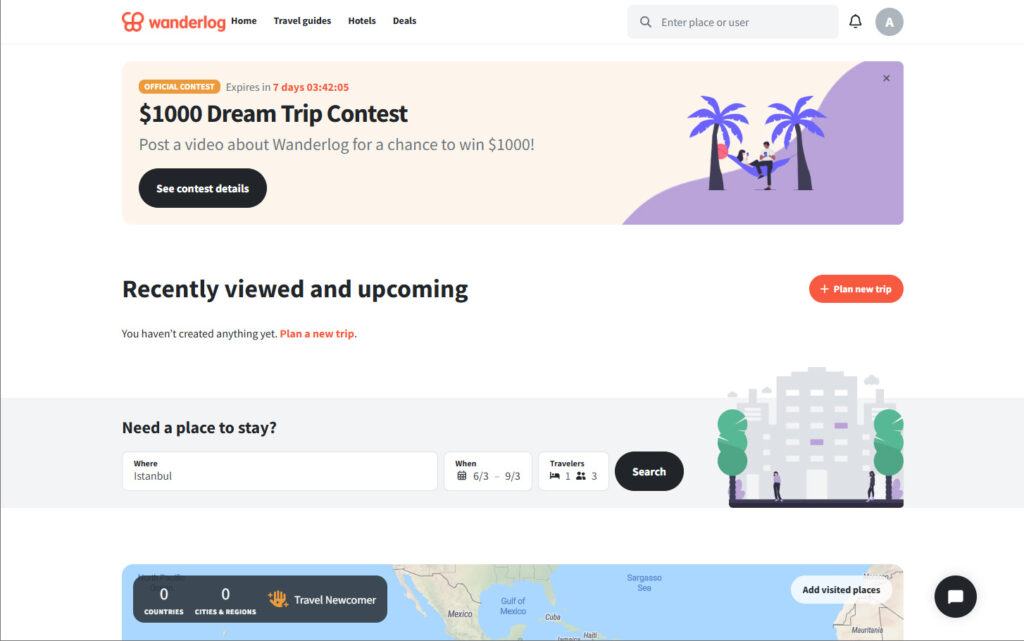
Home page. When you log in, you’re greeted with a “Plan new trip” button, hotel search, and a map marking countries you’ve visited. During my test, there was a “$1000 Dream Trip Contest” banner — Wanderlog is clearly working on audience growth.
Да, логично. Вот исправленные версии:
Hotels:
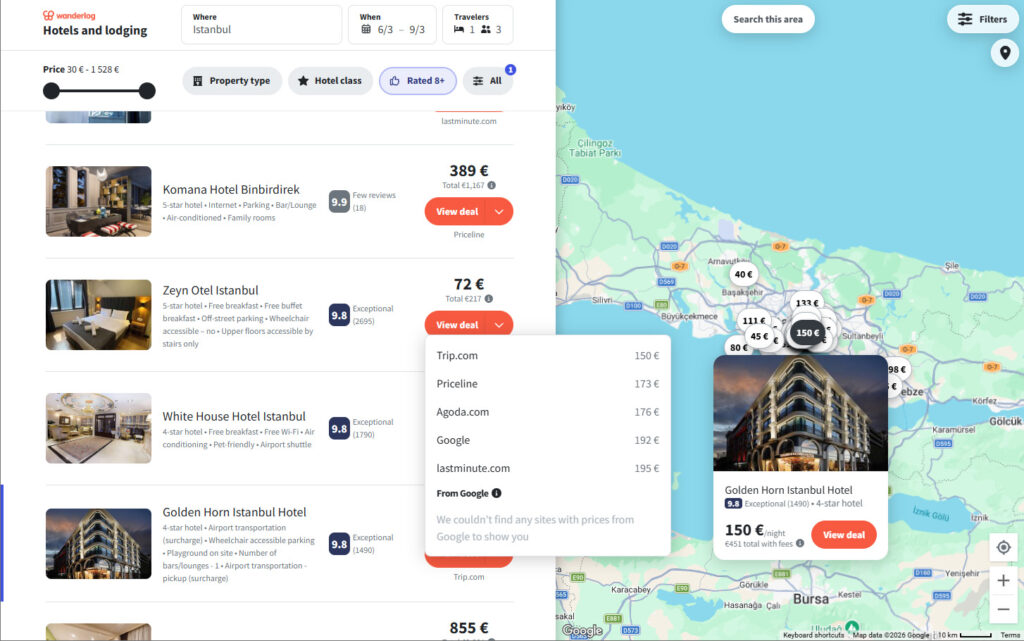
Hotels. The hotel aggregator works transparently: it shows 368 options for Istanbul with prices from $32 to $1,650 per night. Sorting by user rating, filters by class and price. Prices come from Booking.com and Google — and importantly, Wanderlog states this openly: “we show full prices and don’t rank by commission, unlike other sites.” Honest approach.
Explore. The places catalog is arguably the platform’s best feature without AI. Each place has ratings, photos, reviews, and most importantly, “Mentions” — references from real travel blogs and publications. This isn’t just Google Maps; it’s aggregated recommendations from people who’ve actually been there.
Bottom line without AI: Wanderlog is a sleek hybrid of Booking and TripAdvisor with a convenient map. A useful tool for organizing an already-planned trip, but not a replacement for planning from scratch.
Wanderlog AI Test: Istanbul Itinerary
Creating a trip is simple: enter the city name, dates — and you land in a workspace with a map and AI assistant chat. Enter your prompt — and off you go.
Which Prompt Works Best: Three Variations
In this Wanderlog review test, I used three levels of prompt detail to see how Wanderlog handles different amounts of input.
Option 1 — Short (minimal context):
Plan a 4-day family trip to Istanbul. 2 adults + 1 child (7 years old). We want local food, shopping (clothes, souvenirs), and the real Istanbul vibe. March 2026.
Option 2 — Medium (more details, closer to a real request):
Plan a 4-day family trip to Istanbul, Turkey. 2 adults and a 7-year-old child. We’re interested in: authentic Turkish food (street food + restaurants), shopping for clothes and souvenirs (Grand Bazaar, local markets), key sights but without rushing, and kid-friendly activities. Budget: moderate. March 2026.
Option 3 — Detailed (maximum context):
Plan a 4-day family trip to Istanbul for 2 adults and a 7-year-old. We want the authentic Istanbul experience: Turkish breakfast spots, street food in Karaköy, a nice dinner with Bosphorus view. Shopping: Grand Bazaar for souvenirs, local markets for leather and textiles. Must-see sights without exhausting the kid. We prefer walking-friendly neighborhoods. Budget: moderate, no luxury hotels but comfortable. March 2026.
Result: The short prompt produced a basic plan, but the AI made many assumptions on its own — including budget level and activity types. The medium prompt (which I used for the main test) delivered a balanced response. The detailed prompt, as expected, gave the most accurate match to the request — but this tests how well AI follows instructions rather than its ability to “understand” travelers.
Takeaway: The more details in your prompt, the less AI fills in the blanks. But given the 5 free message limit, a detailed first prompt saves your questions for refinements.
Question 1 — Day-by-Day Itinerary
My prompt:
Plan a 4-day family trip to Istanbul, Turkey. 2 adults and a 7-year-old child. We’re interested in: authentic Turkish food (street food + restaurants), shopping for clothes and souvenirs (Grand Bazaar, local markets), key sights but without rushing, and kid-friendly activities. Budget: moderate. March 2026.
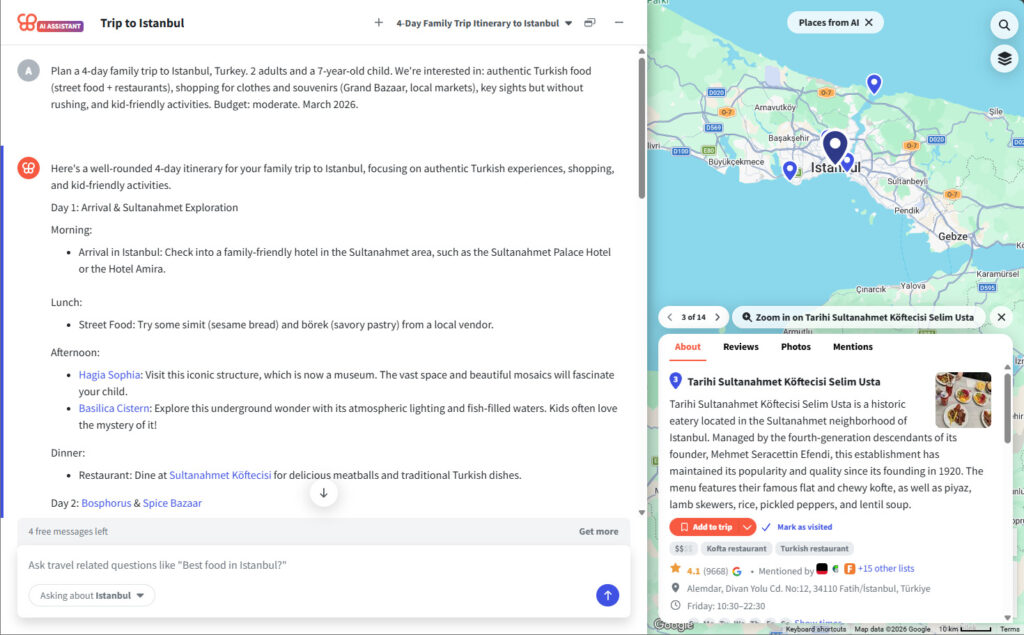
The Wanderlog AI delivered a structured 4-day plan:
- Day 1: Sultanahmet — Hagia Sophia, Basilica Cistern, Sultanahmet Köftecisi for lunch
- Day 2: Bosphorus + Spice Bazaar
- Day 3: Grand Bazaar + shopping
- Day 4: Miniatürk, Gülhane Park
Specific restaurants: Sultanahmet Köftecisi, Karaköy Güllüoğlu (baklava), Hamdi, Çiya Sofrası. Not just “try local food” but actual places with addresses.
The map is a separate story. While generating the itinerary, Wanderlog automatically added pins to the interactive map. To the right of the chat, a map appeared with markers for places from the itinerary and info cards — for example, the Sultanahmet Köftecisi card showing a 4.1 rating (9,668 Google reviews), description, and mentions from 15+ travel lists. This is powerful: you see the route not just as text but geographically, in real-time during planning.
⚠️ Pro Tip: Specify Your Arrival and Departure Times
Wanderlog suggests a plan starting from early morning on Day 1 — the AI doesn’t ask what time you arrive. In the free version, clarifying “we land at 2 PM” uses up one of your five precious messages.
Solution: Include timing in your first prompt. For example: “…March 2026. We arrive on Day 1 at 2 PM and leave on Day 4 at 8 PM.”
This saves a message and gives you a realistic plan from the start.
Question 2 — Budget Breakdown
My prompt:
Can you break down the estimated budget for this trip? Include accommodation, food, transport, activities, and shopping separately.
The Wanderlog AI provided a breakdown:
- Hotel: $400–600 (3 nights, family room)
- Food: $480–540
- Transport: $120
- Activities: $120
- Shopping: $100–200
Total: $1,220–$1,580 for 4 days. The figures look realistic for a moderate budget in Istanbul in spring 2026 — at least, $130–200/night for a hotel is market rate, not fantasy.
Question 3 — Family-Friendly Neighborhoods
My prompt:
Which areas of Istanbul are best for families with kids? And which should we avoid?
Here the AI gave a useful, practical answer:
- Sultanahmet — good, touristy, safe, everything nearby
- Beyoğlu and Kadıköy — good for walks
- Taksim late at night and parts of Fatih — recommended avoiding
- Grand Bazaar: fine, but better in the morning and no longer than 1-2 hours with a child
These aren’t generic tips but specific neighborhood navigation — exactly what you need when planning with kids.
Question 4 — Accuracy Check: Hagia Sophia
My prompt:
Is Hagia Sophia a museum or a mosque now? What’s the entry fee?
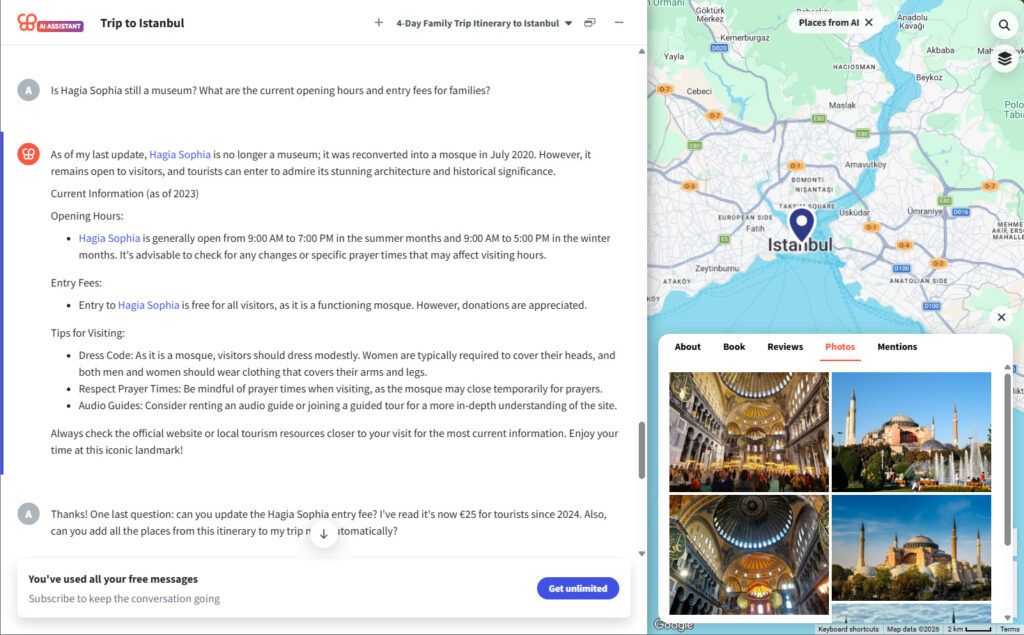
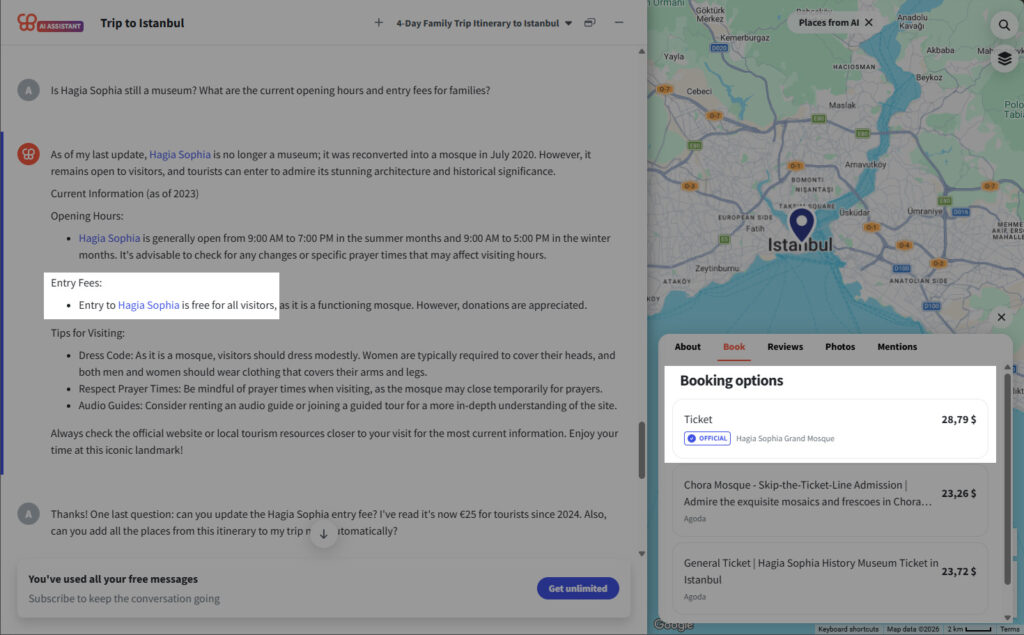
This is where problems started. In the itinerary, Wanderlog wrote: “Visit Hagia Sophia — it’s now a museum.” This is wrong: Hagia Sophia became a mosque in 2020.
I clarified. The AI corrected itself — called it a mosque. Good. But then added: “Entry is free” — and this is also wrong: since 2024, entry costs €25 for tourists. The AI even wrote in parentheses “as of 2023,” essentially admitting the data is outdated.
This is a key point: Wanderlog AI operates on data with a 2023 cutoff date. For rapidly changing information (prices, opening hours, venue status), this is critical.
Question 5 — Data Updates and Map Limitations
My prompt:
Actually, the entry fee for Hagia Sophia is now $27 for tourists (changed in 2024). Can you add some more breakfast spots to the map?
I informed about the €25 fee. The AI accepted the correction and updated the information in its response. But here another limitation emerged: the AI cannot add new places to the map from chat. The map is generated automatically with the first response, but after that — manual mode only. The AI literally wrote: add them via Google Maps yourself.
And immediately after this — paywall.
Free Version Limit: 5 Messages
After the fifth question, this appeared: “You’ve used all your free messages. Subscribe to keep the conversation going” — and a “Get unlimited” button.
I verified this twice: in Dubrovnik and Istanbul. The limit is the same — 5 messages per trip. In practice, this means:
- 1 message — main itinerary
- 1 — budget
- 1 — neighborhoods
- 1 — Hagia Sophia clarification
- 1 — map and wrap-up
Enough for a basic framework. Not enough for clarifications, alternatives, or detailed planning. If you want to work with AI seriously, 5 messages is the lobby, not the apartment.
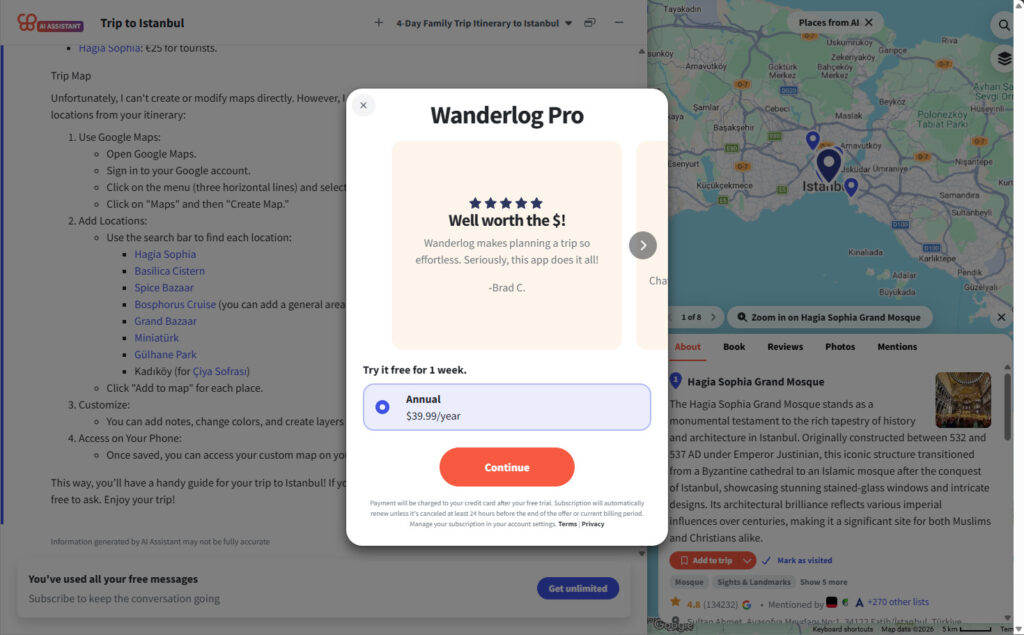
Wanderlog Pricing: Free vs Pro
| Free | Pro ($39.99/year) | |
|---|---|---|
| Trip planning + map | ✓ | ✓ |
| Explore + Hotels | ✓ | ✓ |
| Budget tracker | ✓ | ✓ |
| AI assistant | 5 messages | Unlimited |
| Offline maps | ✗ | ✓ |
| PDF export | ✗ | ✓ |
| Ads | yes | no |
For comparison: Layla AI — $49/year, ChatGPT Plus — $20/month ($240/year), Wanderlog Pro — $39.99/year. Price-wise, Wanderlog Pro sits in the middle. But it’s important to understand: these aren’t direct competitors — each tool does something different.
Based on my Wanderlog review testing, here’s what stands out: Wanderlog Pros and Cons
Pros:
- Interactive map with automatic pins — best implementation in class. Seeing your route on a map in real-time while talking to AI is genuinely useful, not just pretty.
- Explore with travel blog mentions — not just ratings but aggregated real recommendations. There’s a difference.
- Structured budget tracker with category breakdown.
- AI suggests specific restaurants with addresses, not abstract “try local cuisine.”
- Transparent hotel search without hidden commissions — at least, that’s what the service claims.
- Free version is functional even without AI.
Cons:
- AI runs on outdated data. Hagia Sophia — “museum” (wrong since 2020). Prices “as of 2023.” For travel planning, this matters: the world changes.
- 5 free messages is too few for proper planning. Essentially, it’s a demo, not a tool.
- AI cannot add places to the map from chat — the map generates once with the first response.
- AI doesn’t ask about arrival/departure times — plans from morning of Day 1, which rarely matches reality.
- AI doesn’t check weather, seasonal closures, or current attraction prices.
- In the Dubrovnik test, AI suggested hotels at $430–860/night for a “moderate budget” request — clear misunderstanding of budget context.
Who Is Wanderlog For?
Ideal for independent travelers who like planning visually and want everything in one place: itinerary, map, budget, hotels.
Works well for families with kids — Explore can filter kid-friendly places, and the map helps assess logistics.
Not suitable for those expecting “press button, get finished plan” without clarifications and data verification. The AI assistant here is a good starting point but not the final answer.
Wanderlog Review Verdict: ★★★★☆ (4/5)
Wanderlog is the best free AI trip planner by combined functionality when you consider the AI + map + Explore + Hotels bundle.
But it’s important to understand the architecture: Wanderlog’s main strength is the map, Explore, and organizer. The AI assistant is a useful starter helper that sketches out the framework. Final data verification (prices, venue status, accuracy) still needs to be done yourself.
5 free messages is enough to understand if the tool works for you. If it does — $39.99/year is a reasonable price for those who travel at least once or twice a year.
For me, Wanderlog remains in my toolkit — primarily for the map and Explore. But for serious planning, I always supplement it with ChatGPT or another AI without message limits.
Related Articles
- AI Travel Planner Test: I Tested 3 Tools on a Real Dubrovnik Trip
- Layla AI Review
- Best AI Trip Planners 2026 → coming soon
Personally tested: February 2026. All screenshots from real testing on wanderlog.com.
Leave a Reply