
iMean AI doesn’t call itself a trip planner. It calls itself a travel agent. The difference is in the ambition: this isn’t just an itinerary generator — it promises to find flights, match hotels, build routes, and refine them through conversation.
Unlike Wonderplan’s static form, iMean AI has a free-text input field, a real dialogue, and a Deep Planning mode. You can ask follow-up questions, request changes to a single day, or verify prices mid-conversation.
Sounds promising. I put iMean AI through a full iMean AI review: baseline plan, Day 1 revision for a late arrival, price accuracy checks, and a Deep Planning extension for a public holiday. Here’s what worked — and where the tool contradicted itself.
What Is iMean AI?
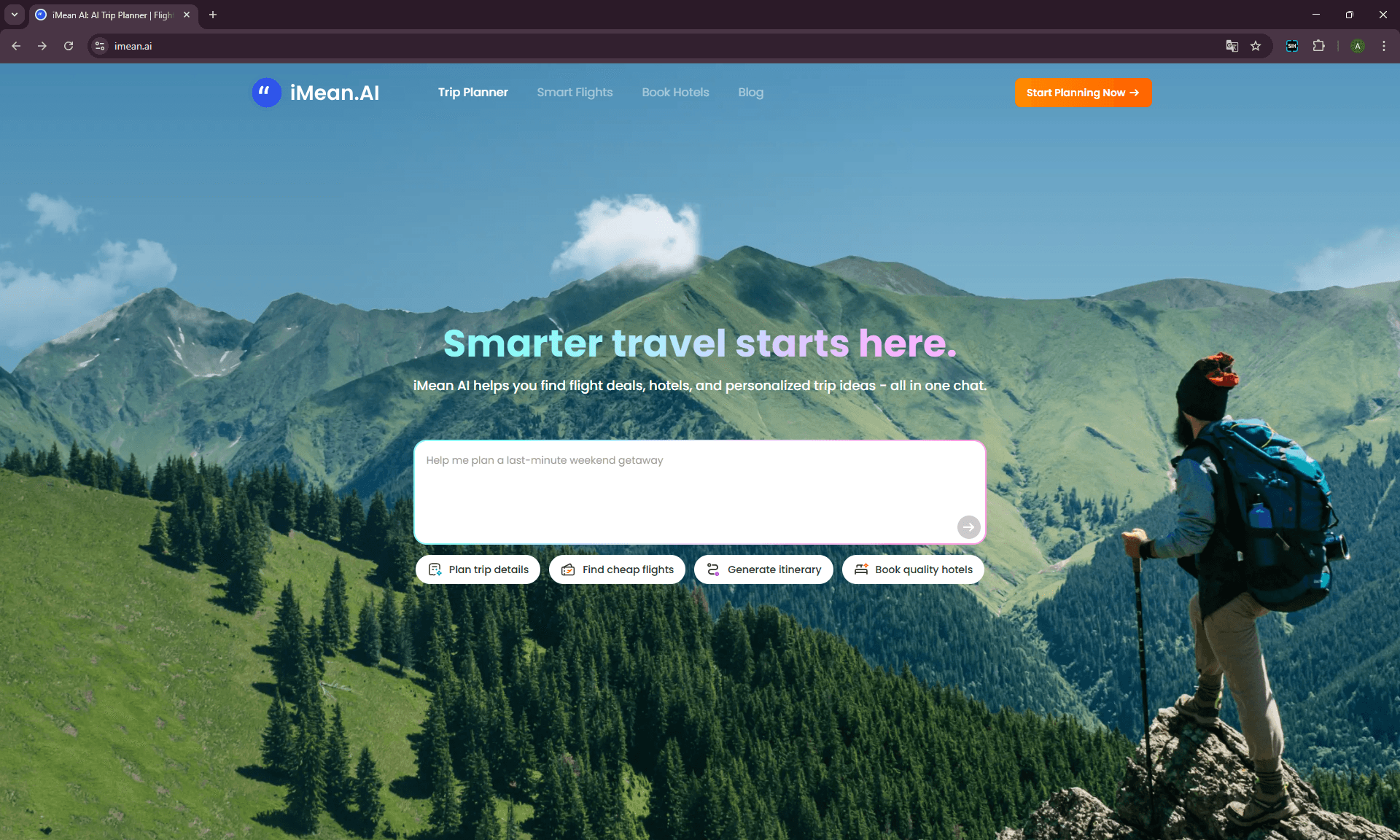
iMean AI is a freemium AI travel agent that works through chat. You type a request, and it returns a detailed response with an itinerary, hotel recommendations, restaurants, and a map.
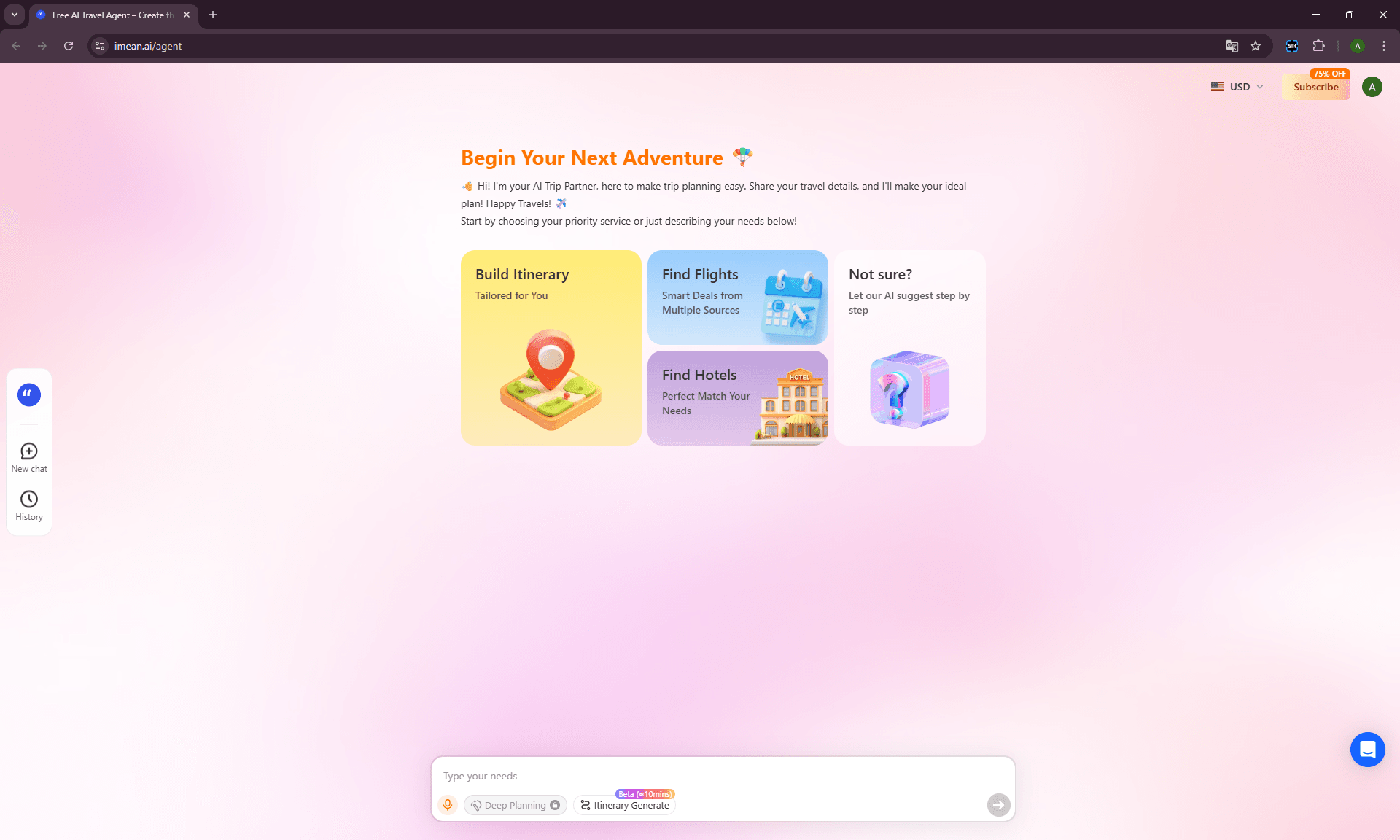
The service has two entry points: a main landing page (imean.ai) with a prompt field and quick actions (Plan trip, Find flights, Generate itinerary, Book hotels), and a separate agent page (/agent) with Deep Planning and Itinerary Generate modes. Same product, two different interfaces — which is already slightly confusing.
The key difference from Wonderplan: iMean is a conversational AI. You can ask it to “revise only Day 1,” “verify a ticket price,” or “account for airport delays.” Wonderplan can’t do any of that.
Test Scenario
The same Budapest trip we used for our Wonderplan Review — so results could be compared. Though, to be fair, the comparison turned out somewhat uneven: these are tools of a different class entirely. It’s like comparing a bicycle to an electric scooter — both get you there, but they work in completely different ways.
- City: Budapest
- Dates: 28–30 April 2026
- Group: 2 adults + 1 child (8 years old)
- Style: relaxed, realistic, minimal backtracking
- Exclusions: thermal baths and aquarium (already visited)
- Context: midday arrival, possible 1–2 hour delay due to EES
The prompt included everything Wonderplan failed on: EES awareness, child context, exclusions, and a request to keep Day 1 lighter.
First Response: Two Tabs, Two Different Plans
An accidental side test happened here. I opened both interfaces (main page and /agent) in two browser tabs and submitted the same prompt simultaneously.
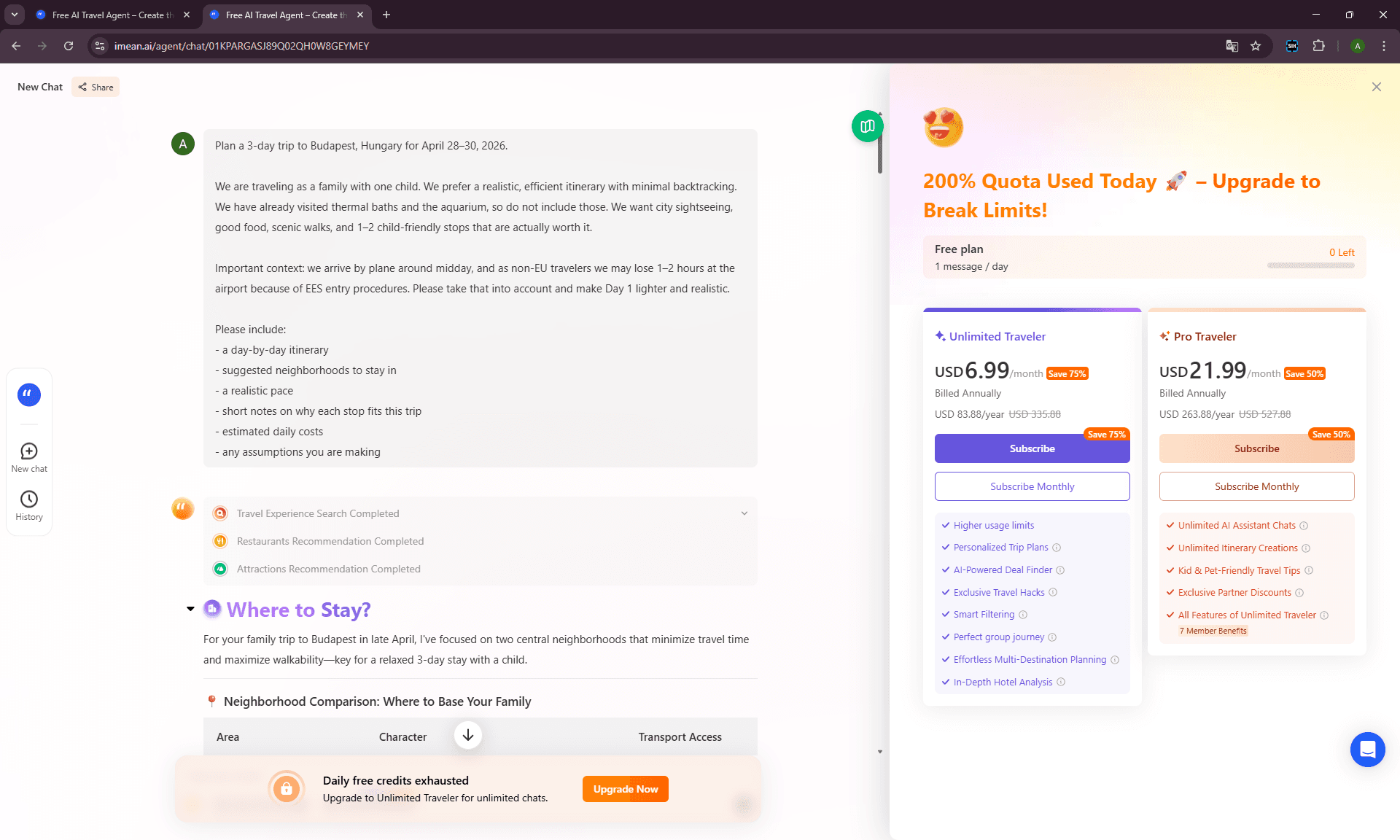
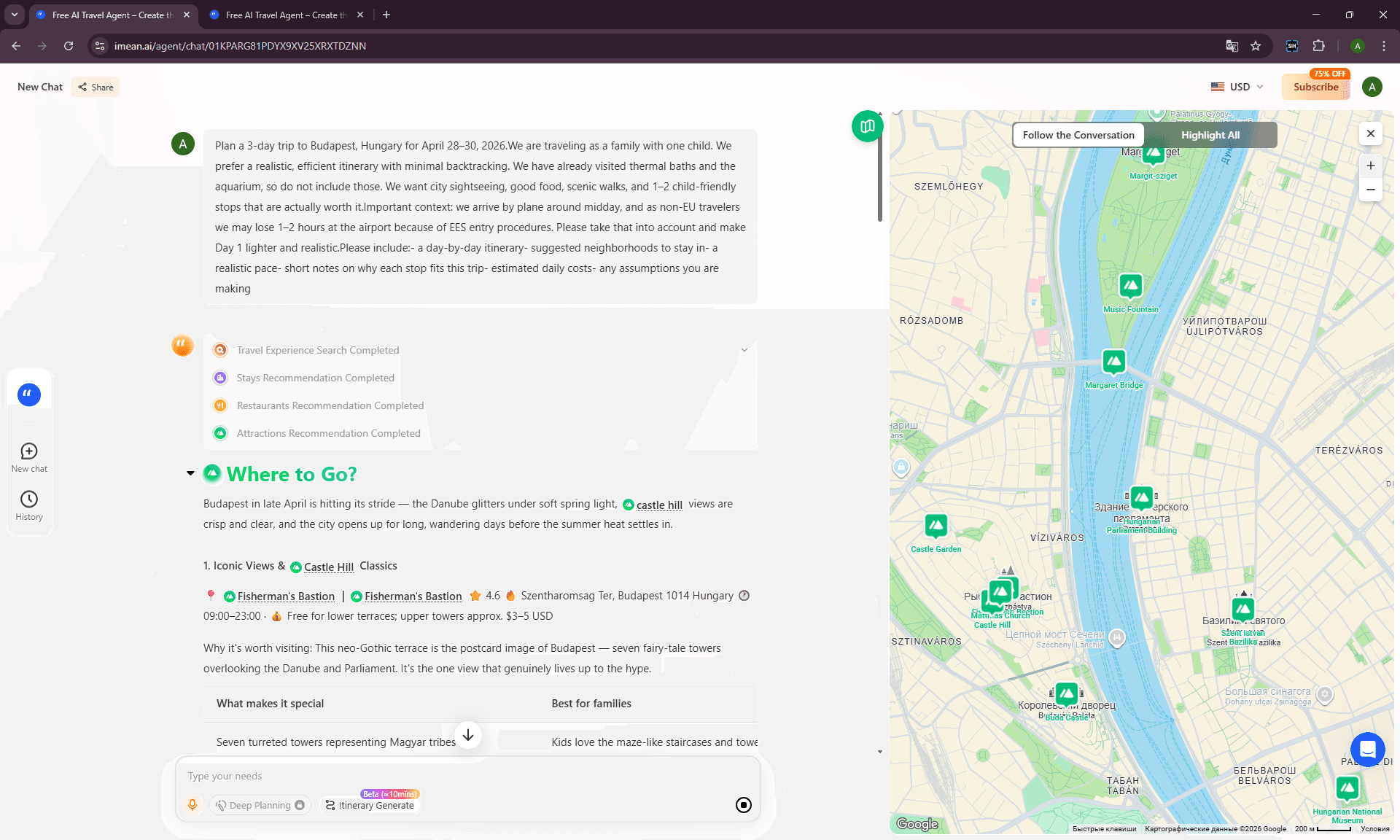
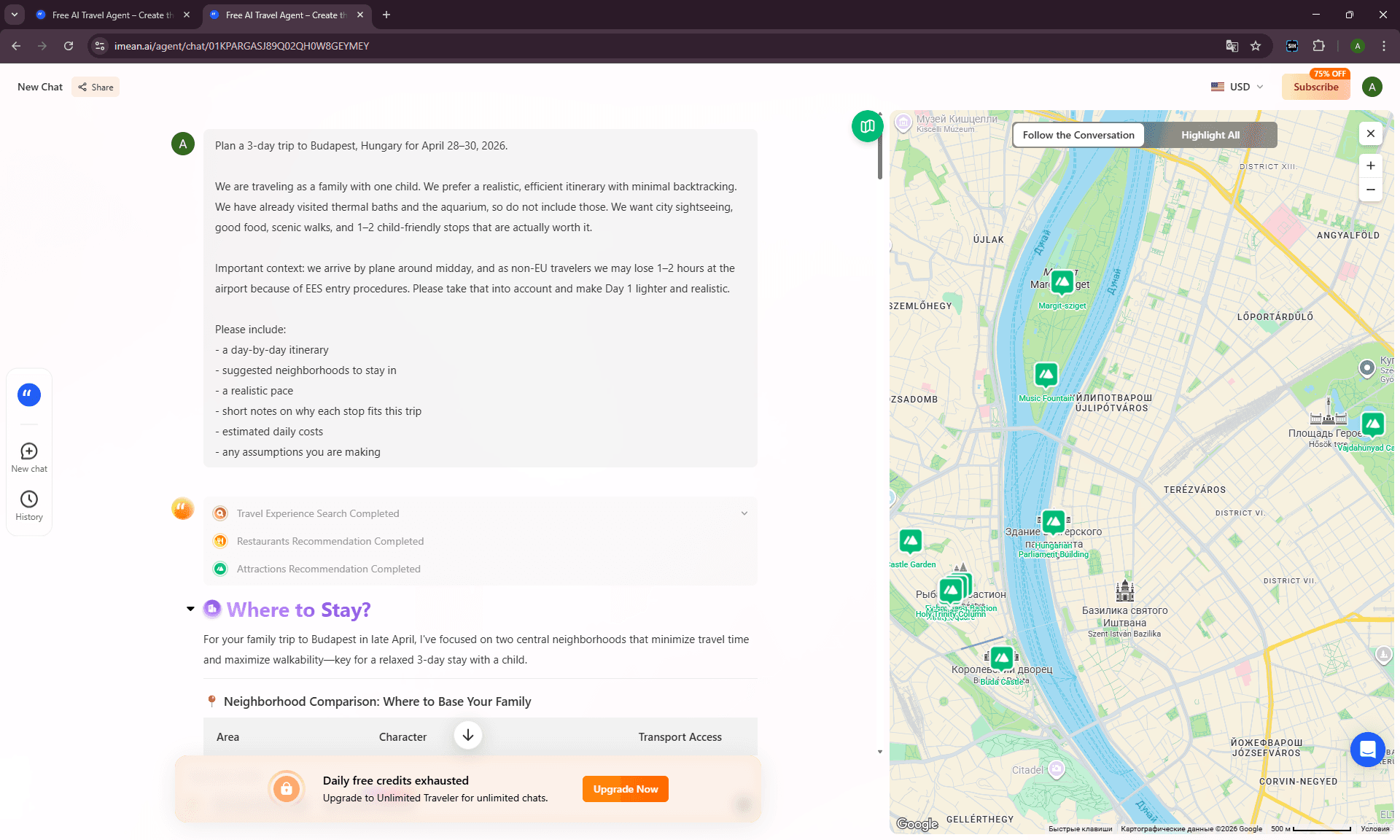
Both tabs started generating in parallel. iMean went through several stages — Travel Experience Search Completed, Restaurants Recommendation Completed, Attractions Recommendation Completed — and began building the plan: Where to Stay, Where to Go, About Your Trip.
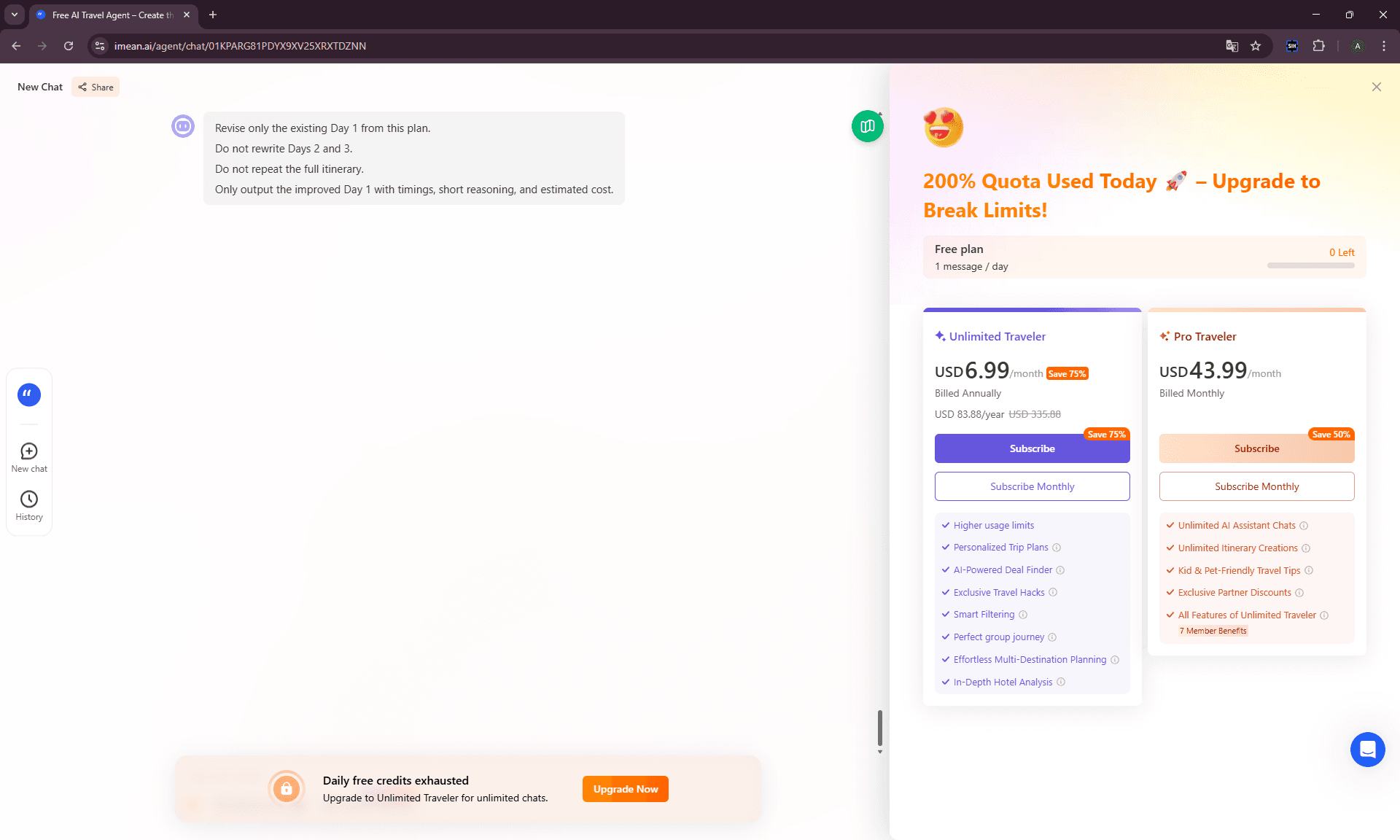
Then the paywall hit: “Daily free credits exhausted. 200% Quota Used Today.”
But here’s the revealing part: two parallel requests with an identical prompt produced two different plans. One focused on neighborhood comparisons (District V vs District VII with a comparison table), the other led with attraction recommendations. Restaurant sets differed too.
This means iMean doesn’t cache a single template — it generates variations on the fly. For users, that’s both a plus (variety) and a minus (no reproducibility guarantee).
The Paywall: Not Instant, But Clever
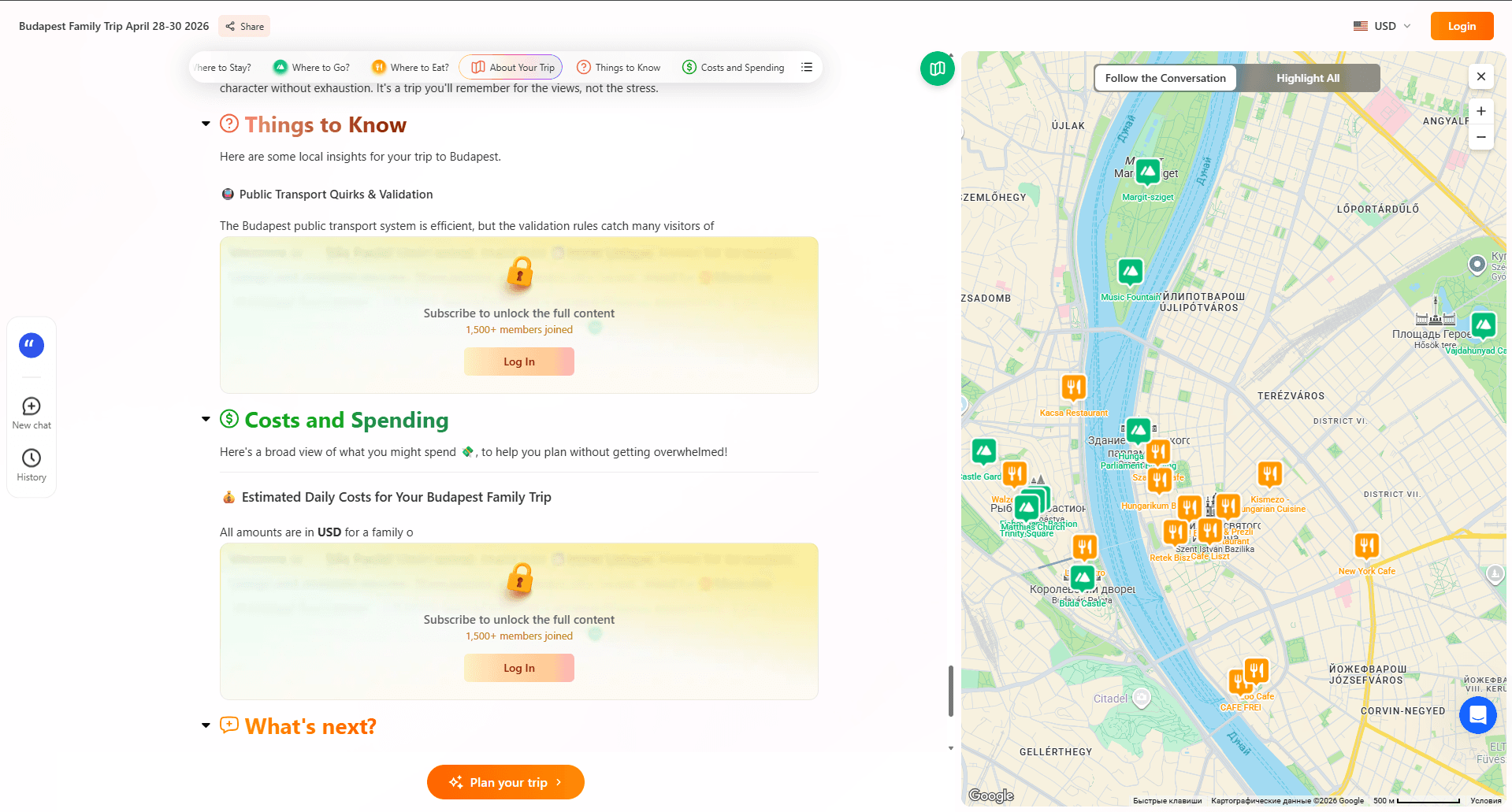
An important detail: the paywall doesn’t trigger at the moment you submit a prompt. It fires after generation has already started. The system completes several steps (search, restaurants, attractions), shows partial results — and only then blocks access.
For users, this creates a frustrating experience: the tool appears to be working, reveals pieces of the plan, then locks the rest behind a subscription screen.
Another detail: the site states “Free plan: 1 message / day”, but in practice the input field only locks after the second prompt. So the real limit is 2 messages per day, not one. Not a bug — an undocumented feature that at least gives you one chance to refine.
Day 1 Revision: iMean AI Understands Context
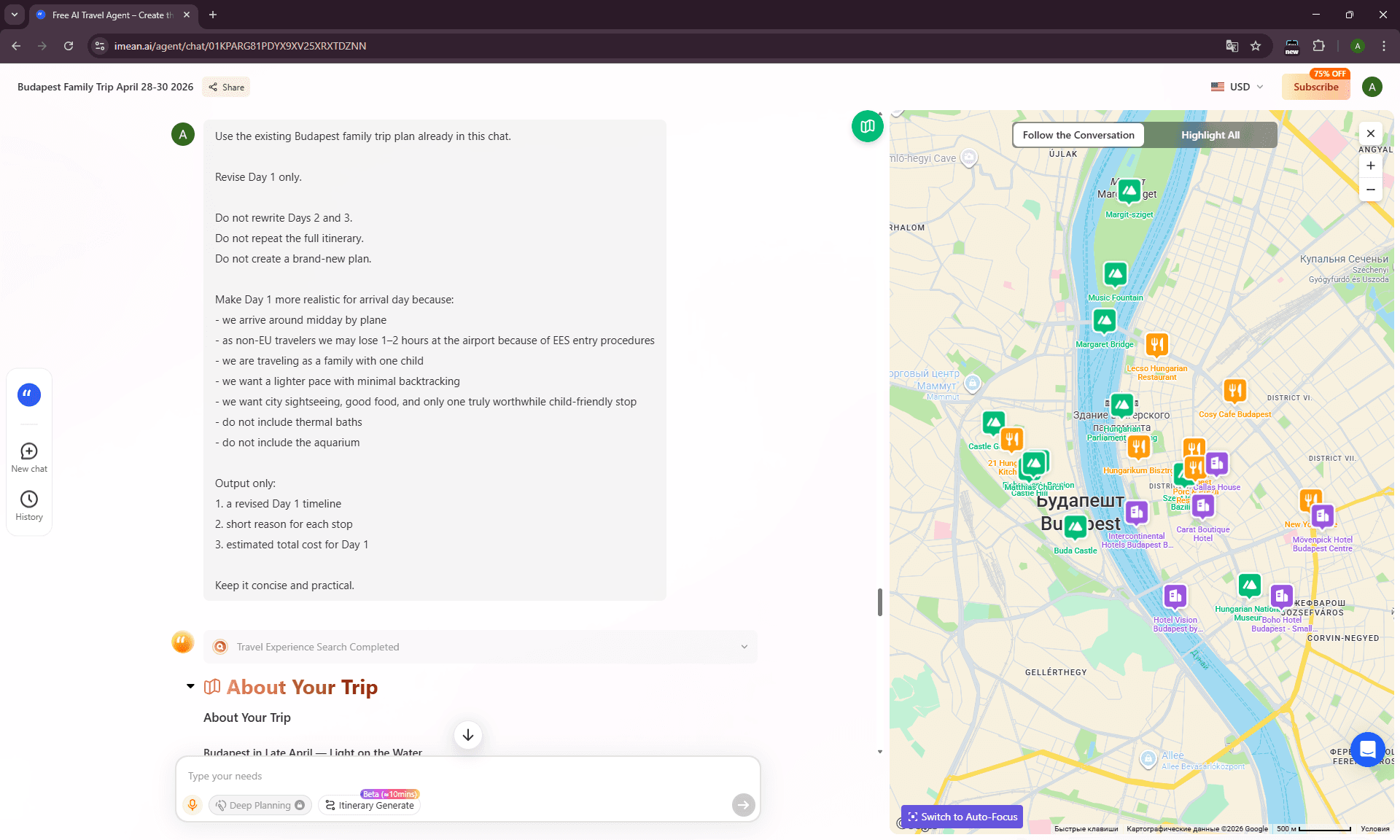
The next day, I sent a targeted request: revise only Day 1, account for a late arrival and EES delay, don’t touch the other days. A detailed prompt with specific constraints.
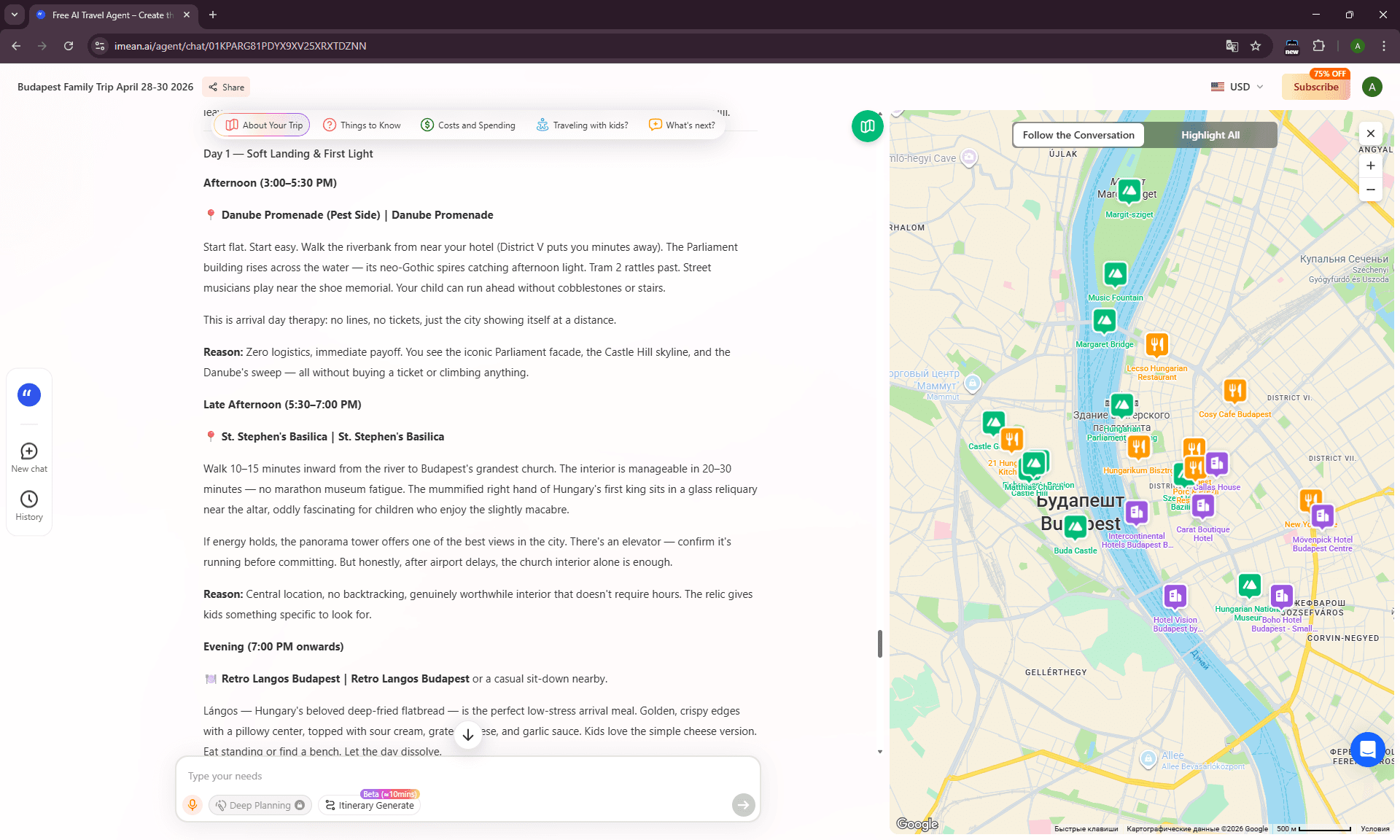
The result was a pleasant surprise. iMean:
- Didn’t rebuild the entire plan — edited exactly Day 1
- Accounted for EES — noted we’d realistically reach the hotel by 2–3 PM
- Lightened the day — three stops instead of seven: Danube Promenade → St. Stephen’s Basilica → street food (lángos)
- Explained the logic — why each stop fits an arrival day
- Gave a cost estimate — $40–55 for the family on Day 1
This is a fundamentally different level compared to Wonderplan, where deleting one place produced “No recommendations available.”
But iMean didn’t hold the strict output format — it added a “Why This Works Better” block and a paragraph about Days 2 & 3, even though I only asked for Day 1. Not critical, but the tool tends toward verbosity.
Price Accuracy Check: iMean AI Contradicts Itself
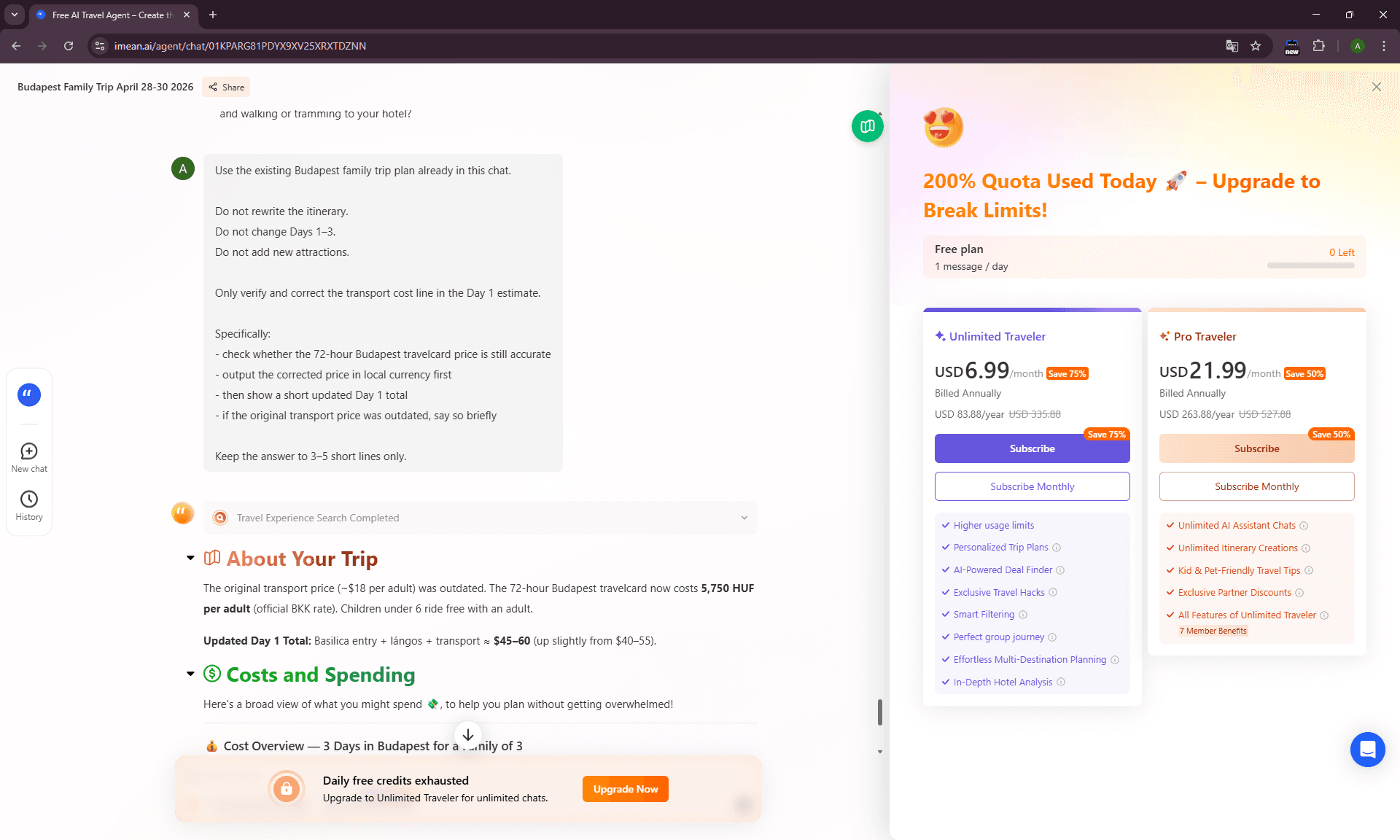
Third test: I asked iMean to verify the 72-hour travelcard price. It corrected the old figure ($18) to the current rate (5,750 HUF) and recalculated the Day 1 total. Good.
Fourth test: verifying the St. Stephen’s Basilica panorama cost. This is where things got interesting.
In the same response, iMean wrote:
- “Where to Go” block: “panorama price is ~2,000 HUF (~$5.50) — your Day 1 estimate is accurate”
- “What’s next” block: “panorama ticket is ~$12 per adult — higher than originally estimated”
$5.50 and $12 in the same message. Not a typo — two different system blocks producing different numbers for the same question.
For a user planning a trip budget, this is a problem. Which number to trust? The AI doesn’t know. And it doesn’t warn about the discrepancy.
Deep Planning: The Strongest Result in This iMean AI Review
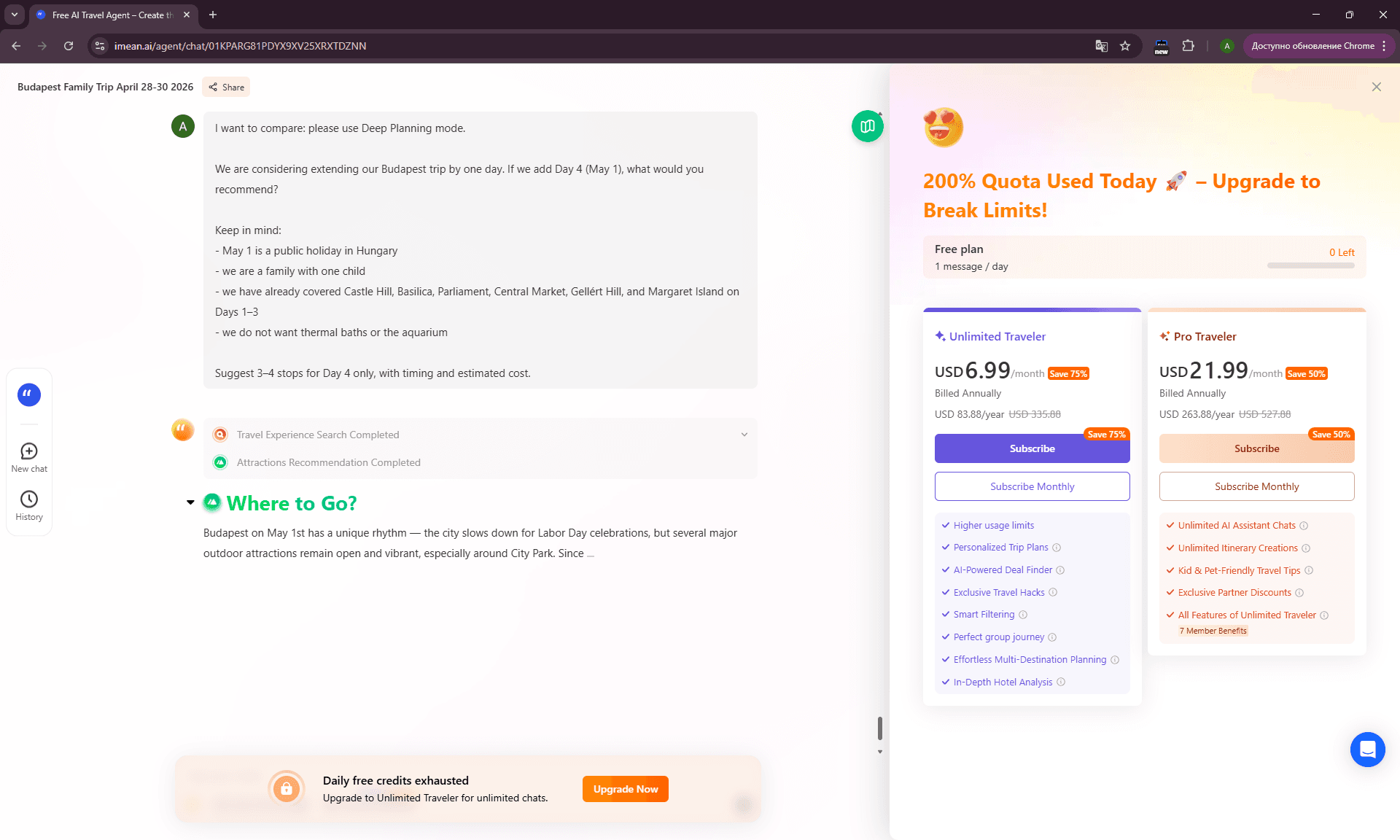
The final test: Deep Planning mode (Beta). I asked iMean to plan Day 4 (May 1), noting that it’s a public holiday in Hungary and that we’d already visited the main sights on Days 1–3.
The response impressed.
iMean understood the holiday context. It noted that many museums would be closed on May 1, Central Market Hall wouldn’t operate, but parks and street festivals would be active. It recommended exactly what makes sense for that day.
The recommendations were genuinely non-standard: City Park with boating and picnics, Budapest Zoo with specific HUF prices ($14/adult, $9/child), and — the standout — Gyermekvasút (Children’s Railway). An 11-km narrow-gauge railway through the Buda Hills, operated by children in uniform. This isn’t from a top-10 tourist template — it’s a genuinely niche recommendation.
It provided a cost table ($65–75 for Day 4), warned about reduced public transport schedules, reminded us to carry cash for street vendors, and suggested light layers with a rain jacket. This was objectively the strongest response from any tool we tested on Budapest.
Share Link and Print: Two Extremes
Share works well — almost too well. The link opened on a different computer without any authentication. It’s a public unlisted URL: anyone with the link sees the full plan. Convenient for sharing, but worth knowing.
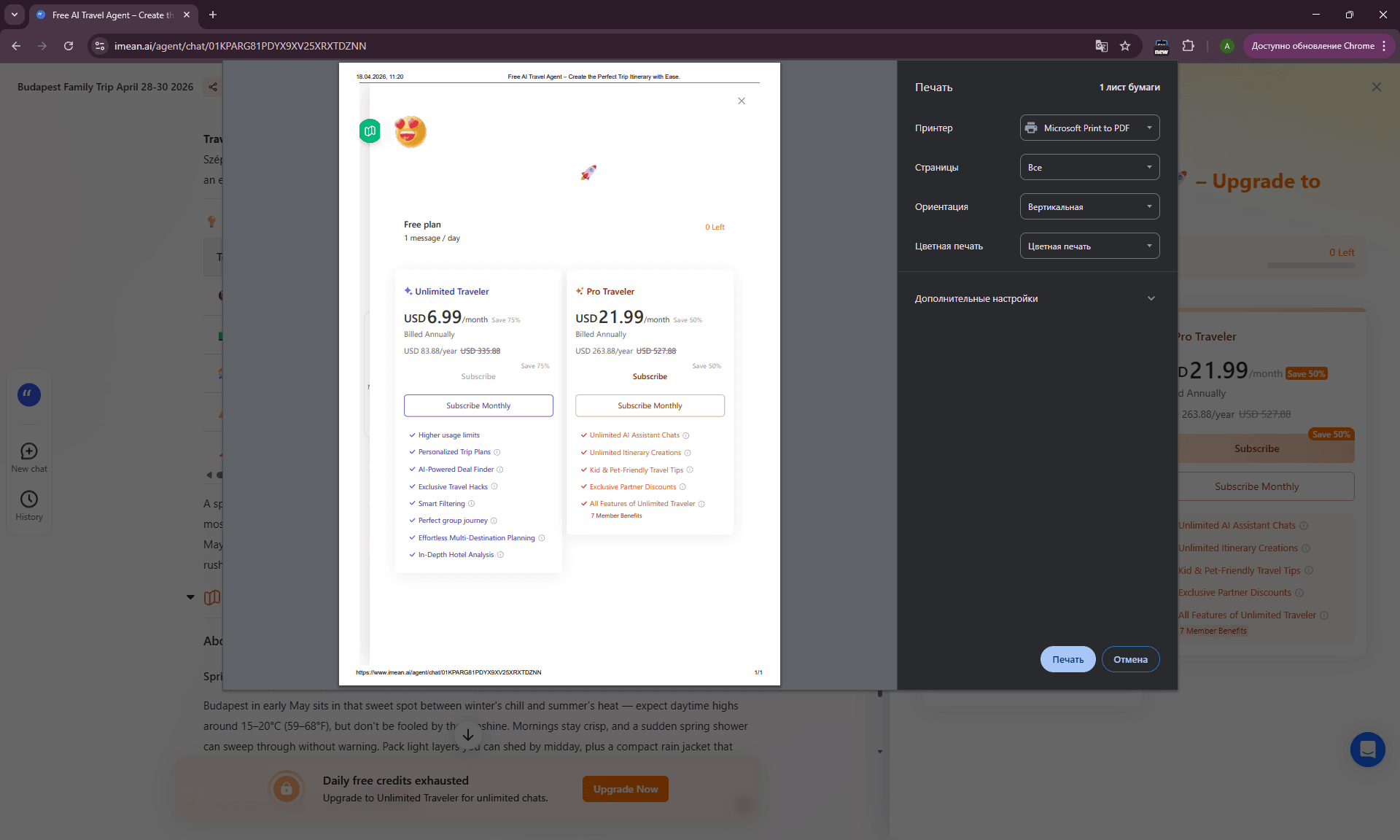
Print doesn’t work properly. When you try Ctrl+P, the result depends on the screen state: if the paywall popup is open, you get a page of subscription pricing. If you close the paywall, you get only the map. In neither case does the actual plan text, restaurants, or itinerary make it to the printout. For a travel service where printing your route is a normal use case, this is a serious UX gap.
How iMean AI Performed in the Milan Test
In our comparison of 7 AI trip planners on a real Milan trip, iMean AI stood out as one of the most detailed tools: it generated 12 hotel options, suggested additional attractions like Castello di Vezio, and generally provided more specifics than most competitors.
But it also missed Museo del Novecento (suggesting Duomo Terraces instead) and didn’t warn about the marathon or EES delays.
Pricing
| Plan | Annual billing | Monthly billing | What’s included |
|---|---|---|---|
| Free | $0 | $0 | 1 message/day (actually 2) |
| Unlimited Traveler | $6.99/mo ($83.88/yr) | $27.99/mo | Unlimited chats, Personalized plans, Deal finder |
| Pro Traveler | $21.99/mo ($263.88/yr) | $43.99/mo | All Unlimited features + Kid-friendly tips, Partner discounts |
The main catch: the gap between annual and monthly pricing. Unlimited Traveler costs $6.99/mo on annual billing, but $27.99/mo when paid monthly — a 4x difference. Pro Traveler: $21.99 → $43.99.
No trial. No free period. Either the 2-message daily limit, or a subscription commitment.
Pros and Cons
Pros
- Real conversational AI — refine, revise, verify
- Understands context (EES, child, public holidays)
- Deep Planning delivers non-standard recommendations (Children’s Railway)
- Can surgically edit one day without rebuilding the entire plan
- Corrects prices when asked
- Share link works
- Map with route pins
Cons
- Free plan: 2 messages/day — enough for a skeleton + one refinement
- Paywall triggers after generation starts, creating an illusion of access
- Monthly price is 4x the annual rate
- No trial / free period
- Contradicts itself on prices within a single response
- Doesn’t hold strict output format — always adds extra text
- Print outputs only paywall or map instead of plan
- Two parallel requests produce different plans (no reproducibility)
iMean AI vs Wonderplan: Key Comparison
| Criteria | iMean AI | Wonderplan |
|---|---|---|
| Input type | Free text (chat) | Form with dropdowns |
| Plan editing | Works (targeted revisions) | Doesn’t work (No options) |
| Context awareness | Yes (EES, child, holiday) | No (Family ≈ Adult) |
| Personalization | Real (different outputs) | Illusion (same template) |
| Non-standard places | Yes (Children’s Railway) | No (top-10 only) |
| Free access | 2 messages/day | Unlimited |
| Price accuracy | Medium (contradictions) | Decorative |
| Print support | Doesn’t work | Doesn’t work |
Who iMean AI Is For
If you need an AI assistant for iterative planning — build a baseline route, refine details, verify prices — iMean AI is leagues ahead of Wonderplan and on par with ChatGPT as a travel planner.
If you’re willing to pay for a subscription (from $6.99/mo on annual billing, $83.88/year) — this is a working tool with real AI inside. Deep Planning delivers surprisingly strong results.
If you want a completely free tool — 2 messages per day is enough for a first draft and one tweak. For full trip planning, you’d need to stretch testing over a week (2 prompts/day) or switch to ChatGPT Free.
Field test: Rome, October 2026
I ran iMean in a nine-planner test for a real family trip to Rome. It didn’t produce a plan: for more than five minutes it showed status updates and its raw internal reasoning, and no final itinerary appeared. Results from other tools: AI Rome Itinerary Test.
Verdict: ★★★★☆ (4/5)
iMean AI is a real AI travel agent, not a template generator. It understands context, edits plans on request, knows about public holidays, and suggests genuinely non-standard places like the Children’s Railway. Deep Planning mode works.
But there are caveats: the free limit is too tight for proper planning, pricing is aggressive (4x difference monthly vs annual), the tool sometimes contradicts itself on prices, and printing the plan in the free version is impossible (we didn’t test the paid version).
With a paid subscription, results would likely be even better — more iterations, deeper Deep Planning. But the subscription is more expensive than Layla AI ($49/year), and Layla offers a trial period while iMean doesn’t.
If Wonderplan is a pretty storefront with nothing inside, iMean AI is a working tool with a lock on the door. The quality is there — but full access costs money.
Personally tested: April 2026. All screenshots from real testing on imean.ai.
FAQ
Is iMean AI free?
Partially. The free plan states 1 message/day, but actually allows 2 prompts before locking. Full planning requires a subscription starting at $6.99/mo (annual billing).
Can you edit the itinerary in iMean AI?
Yes, and that’s its main advantage. You can ask to revise a single day, verify a price, add context (EES, child). The tool preserves conversation context across messages.
Does iMean AI get prices right?
Not always. In our iMean AI review, it gave two different prices for the Basilica panorama ($5.50 and $12) in the same response. The transport card was corrected accurately. Always verify important figures manually.
How does iMean AI compare to Wonderplan?
iMean is a conversational AI with refinement capabilities. Wonderplan is a form-based generator where editing doesn’t work. iMean understands context (holidays, EES, child), Wonderplan doesn’t.
How does iMean AI compare to ChatGPT for travel?
iMean is specialized for travel: built-in map, hotel and flight search, Deep Planning mode. ChatGPT is more versatile but lacks travel-specific features. Response quality is comparable.
Is iMean AI worth paying for?
Depends on how often you travel. For a single trip, ChatGPT Free is easier. For multiple trips per year with a specialized tool, $84/year (Unlimited) might pay for itself in convenience.
How does iMean AI compare to Layla AI?
Both are conversational AI travel planners that can build and refine itineraries. But Layla is cheaper ($49/year), offers a trial period, and has live data research. iMean offers Deep Planning mode and more detailed outputs, but costs more ($84/year) and has no trial. On a budget — Layla wins. For planning depth — try iMean on its free tier first.
Related:
→ AI Rome Itinerary Test: 9 Planners vs. a Real Family Trip
→ 7 AI Trip Planners on a Real Milan & Lake Como Trip: What Held Up (2026)
→ Wonderplan Review 2026: Honest Test of This AI Trip Planner
→ Layla AI Review 2026: I Tested This AI Trip Planner on a Real Itinerary
→ ChatGPT Travel Planner 2026: Free Prompts That Actually Work