
Looking for the best AI travel planners to plan your next trip? You’re not alone. AI travel planners have exploded in popularity, promising to turn hours of research into minutes of conversation. But which ones actually deliver?
Most “best AI travel planner” lists you find online are rewritten press releases. I wanted real answers — so I tested 10 AI travel planners hands-on, with two of them put through deep real-world testing on actual international trips: Istanbul with Wanderlog and Dubrovnik with Layla AI. The remaining eight I evaluated through hands-on exploration, real itinerary generation, and verification of pricing and live data accuracy.
This guide covers free AI trip planners, premium options, and niche tools for road trips, family travel, and group planning. Whether you want a free AI itinerary generator or a paid travel agent that books flights for you — there’s something here for you.
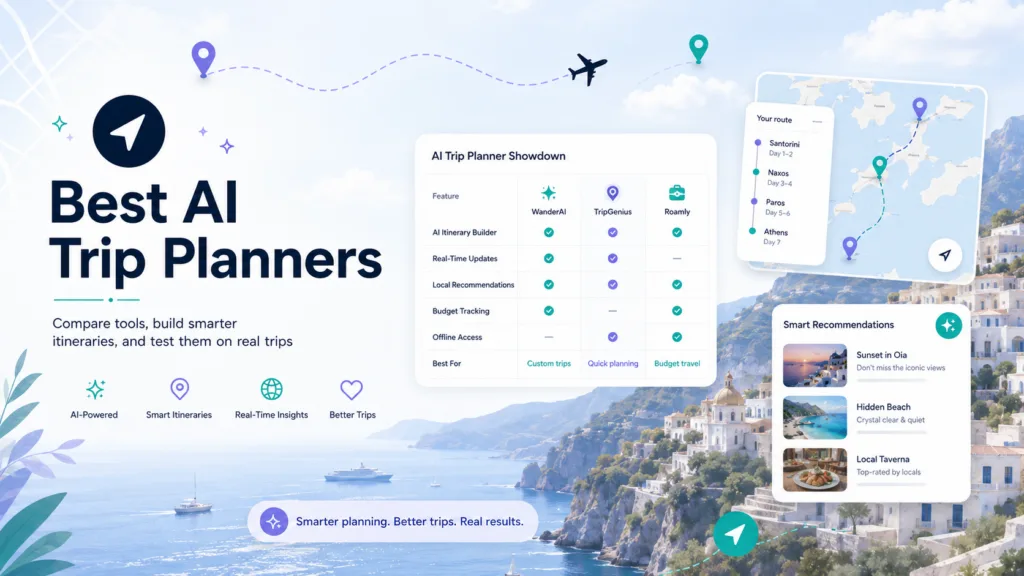
Quick Comparison: Best AI Travel Planners at a Glance
Here’s a quick overview of all 10 tools tested. Click through to detailed reviews for each.
| Tool | Price | Live Data | Flights | Maps | Best For |
|---|---|---|---|---|---|
| Layla AI | $49.99/yr | ✅ Yes | ✅ Yes | Basic | Booking-ready packages |
| Wanderlog | Free / $39.99/yr | ❌ 2023 data | ❌ No | ✅ Best | Visual planning & collaboration |
| ChatGPT | $20/mo (Plus) | ✅ Yes | ❌ No | ❌ No | Flexible Q&A, custom prompts |
| Mindtrip | Free | ✅ Yes | ✅ Yes | ✅ Yes | Visual discovery, group trips |
| iMean AI | Free / $6.99/mo | ✅ Yes | ✅ Yes | Basic | Conversational refinement |
| Wonderplan | Free | ❌ Limited | ❌ No | Basic | Quick simple itineraries |
| GuideGeek | Free | ✅ Yes | ❌ No | ❌ No | Messaging-based travel help |
| Roam Around | Free trial / $10+ (tokens) | ❌ Limited | ❌ No | Basic | Local activities & experiences |
| Curiosio | Free | ❌ No | ❌ No | ✅ Yes | Multi-country road trips |
| Tripnotes | Discontinued | — | — | — | Budget tracking (service closed) |
Want a head-to-head real-world test? See how 7 of these tools performed on a real Milan & Lake Como trip in our Best AI Trip Planner: 7 Tools Tested on a Real Trip.
How I Tested These AI Travel Planners
This isn’t a listicle based on press releases — I actually used these tools on real trips. Here’s what I checked for each:
- Real travel logistics — can it handle flights, hotels, transfers, and timing?
- Live data accuracy — current prices, opening hours, and operational status
- Practical usefulness — actionable plan or just generic text?
- Free vs paid value — what you actually get without a subscription
Two tools — Layla AI and Wanderlog — got deep real-world testing on actual trips. The remaining eight were evaluated through hands-on use, sample itinerary generation, and pricing/feature verification.
1. Layla AI — Best for Booking-Ready Trip Packages
Price: Free trial (3 days) / $49.99/year
Website: layla.ai
Layla positions itself as an AI travel agent, not just a planner. The key difference: it delivers complete bookable packages with real flight prices and hotel options — not just text suggestions.
What impressed me: Live web search returned current data on Hagia Sophia (entry fee, mosque status, dress code) where competitors with static training data got it wrong. Real flight integration through Skyscanner with live prices. Proactive suggestions — Layla warned that a late-night arrival “may be tiring for a 7-year-old.” The plan auto-improved during our conversation, finding cheaper flights and better-located hotels.
Weaknesses: $49.99/year with only a 3-day free trial — no real free tier. PDF export is locked behind Premium. No curated content — “View Details” just opens Google Maps.
Verdict: Best for travelers who want a ready-to-book package with verified live data. Worth it if you travel 2-3 times per year.
Current URL note: I am not listing TripPlanner AI as a separate tool here because the current TripPlanner AI experience opens into a Layla-branded planner. For this comparison, I treat it as part of the Layla ecosystem rather than a standalone competitor.
→ Related: Layla AI Review 2026: I Tested This AI Trip Planner on a Real Itinerary
2. Wanderlog — Best Free AI Travel Planner for Visual Planning
Price: Free / $39.99/year (Pro)
Website: wanderlog.com
Wanderlog has the best map interface of any AI travel planner I tested. Drag-and-drop reordering, automatic route optimization, and seamless collaboration make it the go-to for visual planners and group trips.
What impressed me: The map view groups attractions by day and clusters them geographically — fewer wasted hours in transit. Real-time collaboration: my wife and I edited the same Istanbul itinerary simultaneously. Excellent integration with TripAdvisor, Yelp, and Google reviews. Free version is genuinely usable.
Weaknesses: Training data feels stuck in 2023 — Wanderlog suggested closed restaurants and outdated event schedules during our Istanbul test. No flight integration. Free plan limits collaborator count.
Verdict: The best free AI itinerary planner if you value visual planning and collaboration. Verify operating status before each booking.
→ Related: Wanderlog Review 2026: I Tested This Free AI Trip Planner on a Real Itinerary
3. ChatGPT — Best for Flexible, Custom Travel Questions
Price: Free / $20/month (ChatGPT Plus)
Website: chatgpt.com
ChatGPT isn’t a dedicated travel planner — and that’s its strength. Unlike specialized tools that force you into a template, you can ask anything: how to buy a metro ticket in Milan, whether you need a visa for Turkey, or how to phrase a vegetarian request in Vietnamese.
What impressed me: Maximum flexibility — no rigid form, just conversation. With ChatGPT Plus, web browsing returns current information. Excellent for niche questions (“best gluten-free bakeries in Lisbon” or “kid-friendly day trips from Vienna by train”).
Weaknesses: No maps, no flight bookings, no collaboration. Output is plain text — you’ll need to copy it into another tool. Free version uses older training data and can hallucinate addresses or hours.
Verdict: The most flexible AI travel planner free option (with caveats). Best paired with a structured tool like Wanderlog or Mindtrip for the actual itinerary.
→ Related: ChatGPT Travel Planner 2026: Free Prompts That Actually Work
4. Mindtrip — Best for Visual Discovery and Group Planning
Price: Free
Website: mindtrip.ai
Mindtrip blends AI planning with social discovery. Beyond standard itinerary generation, it has community guides written by real travelers — a hybrid between trip planner and travel social network.
What impressed me: The “Start Anywhere” feature lets you build a trip around any inspiration — a TikTok video, a single restaurant, a destination idea. Community guides with real timestamps and saved-by counts add social proof you don’t get from pure AI tools. Excellent map integration. Strong on family travel context (remembers child age across the conversation).
Weaknesses: No direct ticket booking (only hotels via Expedia). iOS app is limited compared to desktop.
Verdict: The best free AI travel planner for visual planners and group trips. Unique social layer no competitor matches.
→ Related: Mindtrip Review 2026: Honest Test on a Real Family Trip
5. iMean AI — Best for Conversational Plan Refinement
Price: Free (2 messages/day) / $6.99/mo (annual)
Website: imean.ai
iMean AI works through chat. Unlike form-based generators, you can ask follow-up questions, request changes to a single day, or verify prices mid-conversation. Deep Planning mode delivers genuinely non-standard recommendations.
What impressed me: Surgically edits one day without rebuilding the whole plan. Understands context — accounted for EES border delays and public holidays in our test. Deep Planning surfaced niche places like Budapest’s Children’s Railway that template-based tools miss.
Weaknesses: Free plan is just 2 messages/day — enough for a draft and one tweak. Sometimes contradicts itself on prices within a single response. Monthly billing is 4x annual rate.
Verdict: The strongest conversational AI for iterative travel planning, but the free tier is too tight for full trip planning.
→ Related: iMean AI Review 2026: Honest Test of This AI Travel Agent
6. Wonderplan — Best for Quick Simple Itineraries
Price: Free
Website: wonderplan.ai
Wonderplan is a form-based AI itinerary planner — fill in your dates, destination, and preferences, and you get a structured day-by-day plan in minutes.
What impressed me: Clean interface, fast generation, no sign-up wall. Good for first-time AI travel planner users who want a starting template.
Weaknesses: No real refinement — editing the plan often returns “No options available.” Limited context awareness (doesn’t differentiate adult and family trips). Static data, no live verification.
Verdict: Useful for quick first drafts. For serious planning, you’ll outgrow it fast.
→ Related: Wonderplan Review 2026: Honest Test of This AI Trip Planner
7. GuideGeek — Best for Messaging-Based Travel Help
Price: Free
Website: guidegeek.com
GuideGeek takes a different approach from most AI travel planners: instead of making you open another planning dashboard, it works through a chat-style travel assistant. It is useful when you want quick answers while planning or already traveling.
What impressed me: It is fast, simple, and better suited for practical travel questions than building a full multi-day itinerary from scratch. The messaging format works well for comparing local options, checking what to do next, or getting quick ideas without opening another map-heavy planning tool.
Weaknesses: No visual map interface, no full itinerary workspace, and no direct booking flow. It is more of a travel companion than a complete planner.
Verdict: Best as a lightweight AI travel companion for quick answers. Use it alongside a structured planner like Wanderlog, Mindtrip, or Layla AI.
8. Roam Around — Best for Local Activities and Experiences
Price: Token-based — one token buys one trip plan. Packs run 30 tokens for $10, 80 for $20, 150 for $30, with a limited free trial. Checked August 2026; a 50% promotion was running at the time of checking, so these are list prices, not what you may see today.
Working website: roamaround.app
URL note: roamaround.io currently redirects to Layla AI, while roamaround.app still works as a separate Roam Around product.
Roam Around has a slightly confusing URL situation in 2026. The old roamaround.io address now points into the Layla ecosystem, but roamaround.app still opens a separate Roam Around travel-planning experience. I am including the app version here because it remains a distinct product experience from Layla’s main planner.
Roam Around focuses on experiences over logistics. It’s strong on suggesting local activities, hidden gems, and cultural moments.
What impressed me: Solid descriptions of markets, sunset spots, and local culture. Instant generation. Decent city overviews for “what to do” research.
Weaknesses: Ignores logistics — no help with flights, transfers, or timing. Limited booking integration. Bare-bones compared to full-featured alternatives.
Verdict: Use as a supplement for local activity ideas. Pair it with a logistics-focused planner.
9. Curiosio — Best for Multi-Country Road Trips
Price: Free
Website: curiosio.com
Curiosio is a niche specialist: built for road trips across 30 countries. If you’re flying in and renting a car to explore overland, this is your tool.
What impressed me: Smart route optimization prevents zigzagging. Handles complex multi-stop journeys. Budget and time constraints respected. Wikivoyage integration adds real depth on each stop.
Weaknesses: Road trips only — useless for fly-in/fly-out vacations. Only 30 countries (covers majors but not exhaustive). No live flight or hotel data.
Verdict: The best AI travel planner for road trip enthusiasts. Niche, but excellent at what it does.
10. Tripnotes — Discontinued (acquired by Dorsia)
Status: No longer available. The company was acquired by Dorsia and the web product was shut down. What remains is a separate mobile app for saving travel notes — a different product from the planner tested here.
We are keeping this entry rather than quietly deleting it. A list of AI travel planners is more useful when it also shows which ones did not survive — and this one was live when we tested it.
Tripnotes combined itinerary planning with budget management — useful if you were tracking expenses across a long trip.
What impressed me: Per-day budget breakdown. Clean, simple interface. It was free, with no aggressive paywalls.
Weaknesses: Itinerary depth was shallow. Limited context awareness. It was best treated as a budget tool with planning attached, not the other way around.
Verdict: It was useful as a secondary tool for travelers who wanted spending visibility. Not a primary planner.
Which of the Best AI Travel Planners Is Right for You?
After testing all 10, here’s my decision tree:
- Want a free AI trip planner? → Wanderlog (visual) or Mindtrip (group/social)
- Willing to pay for booking integration? → Layla AI ($49.99/yr)
- Want maximum flexibility? → ChatGPT Plus ($20/mo)
- Need iterative refinement? → iMean AI
- Want quick travel answers in a chat-style format? → GuideGeek
- Looking for local activity ideas? → Roam Around
- Planning a road trip? → Curiosio
- Want quick simple drafts? → Wonderplan
For most travelers, the winning combination is Wanderlog (free) for visual planning + ChatGPT for custom questions. If you want a single paid tool, Layla AI delivers the most complete package.
For a real-world head-to-head test of 7 of these tools on an actual Italian trip, see our Best AI Trip Planner: 7 Tools Tested on a Real Milan Trip deep-dive.
Field test: Rome, October 2026
In October 2026 I gave nine AI planners the same request for a real family trip to Rome — two adults and an 8-year-old, landing on a Saturday evening — then checked every plan on the ground. The key test was Sunday, October 4: the first Sunday of the month, when the Colosseum is free and tickets can only be collected at the box office.
| Tool | Result in Rome |
|---|---|
| ChatGPT (free, web search) | Knew about the free Sunday right away |
| Wanderlog | Got it right only after a follow-up question |
| Mindtrip | Missed the free Sunday; listed wrong closing hours — but on the day, it found us a no-line children’s museum |
| MonkeyEatingMango | Moved our 5:05 p.m. arrival to 8:30 a.m. |
| TripBaddie | Assumed we’d arrive by train |
| Runtrip | Dropped our departure day |
| iMean, Wonderplan | Produced no plan |
The full test, with receipts and photos: AI Rome Itinerary Test: 9 Planners vs. a Real Family Trip.
FAQ: Best AI Travel Planners
What is the best free AI trip planner?
Wanderlog and Mindtrip are the strongest free AI travel planners. Wanderlog wins on visual maps and collaboration; Mindtrip wins on community guides and family-trip context.
Is Layla AI worth $49.99 per year?
If you travel 2-3 times per year and value live data plus bookable flights in one tool, yes. For occasional travelers, ChatGPT Plus ($20/mo, cancel anytime) is more flexible.
Can ChatGPT replace dedicated AI travel planners?
Partially. ChatGPT is great for custom questions and flexible Q&A but lacks maps, real bookings, and collaboration. Pair it with a structured planner for best results.
How accurate is AI for travel planning?
Tools with live web search (Layla, Mindtrip, ChatGPT Plus, iMean) are reasonably accurate on current prices and operational status. Tools with static training data (Wanderlog 2023, Wonderplan) regularly miss closures and price changes — always verify before booking.
Which AI travel planner is best for families?
Mindtrip handles family context best — remembers child age, suggests kid-friendly stops, surfaces interactive museums. Layla AI is a close second with its proactive warnings (“late arrival may be tiring for a 7-year-old”).
Related:
→ AI Rome Itinerary Test: 9 Planners vs. a Real Family Trip
→ 7 AI Trip Planners on a Real Milan & Lake Como Trip: What Held Up (2026)
→ I Tested 3 AI Trip Planners on a Real Dubrovnik Trip — Here’s What Actually Worked
→ ChatGPT Travel Planner 2026: Free Prompts That Actually Work
→ AI Travel Planning: Ultimate Beginner’s Guide 2026
Last updated: August 2026; Rome, October 2026. Pricing and features change frequently — verify on official websites before purchasing.