
My daughter is eight, and on that particular afternoon in Budapest she wanted one thing in the world — to see sharks. Not the castle on the hill, not the parliament from the postcards, not yet another baroque church the grown-ups would drag her into. Sharks. A big underwater tunnel with something toothy gliding overhead. Any parent will tell you that an image like that, lodged firmly in a kid’s head since breakfast, doesn’t lose to a landmark from a guidebook.
So I did exactly what I keep telling readers of this blog to do: I opened AI and asked for advice. ChatGPT first, then the Mindtrip planner. For sanity I also peeked into a couple of regular guidebooks. And, as if by quiet agreement, every source gave me the same answer: the Budapest Zoo. A wonderful zoo, no argument there — historic, beautiful, “a must” by everyone’s reckoning. The only problem is that a zoo is not an aquarium, and an eight-year-old who has spent the whole day imagining an underwater world can feel the difference between “animals” and “marine animals” with absolute clarity.
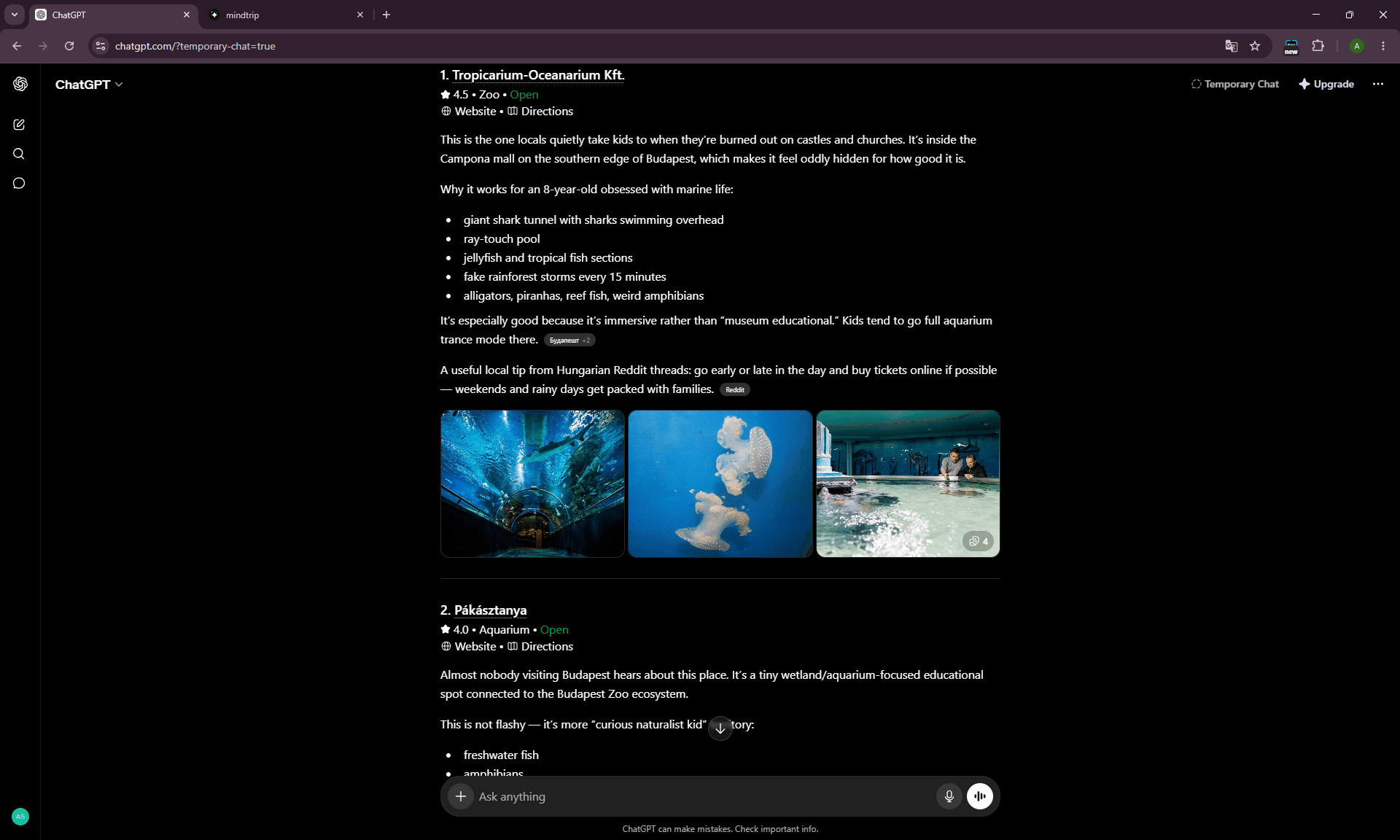
The place we ended up at was suggested by exactly none of the tools. Tropicarium-Oceanarium — on the southern edge of Budapest, inside the Campona shopping center. It sounds underwhelming on paper: an aquarium in a mall. In reality, it’s a glass tunnel with sharks and rays drifting overhead; a touch-pool where the rays can be petted; jellyfish, tropical fish, simulated rainstorms every fifteen minutes; alligators, piranhas, reptiles. My daughter slipped into exactly the aquarium-trance state we’d been working toward all morning, and stayed in it longer than we were physically equipped to handle. We found the place not thanks to AI. We found it in spite of it — frantically Googling on a phone, already on site.

That gap — between what AI confidently recommends and what was actually worth seeing — is something I kept running into. In Brno. In Vienna. In Normandy. In Milan. At some point I stopped just being annoyed about it and decided to measure it. I took two tools — ChatGPT and Mindtrip — and ran them against five real places from our family trips across Europe. Strict three-step protocol: what does AI suggest by default; what does it produce when you explicitly ask for “hidden gems”; and what changes if you ask the question differently.
A spoiler that frames the whole thing: AI isn’t dumb. You just need to know how to use it. On normal, human-shaped queries it missed four out of five of our places. Then I rewrote a single prompt — and it found all of them, first item in the list. Below: how that blind spot is built, what it rests on, and the one trick that fixes it. With real screenshots and real trips behind every claim.
Why AI Tools Default to Tourist Traps (And Miss Real Hidden Gems)
Before we accuse the tools of anything, we should understand the mechanics. Otherwise we end up with the cheap “AI is dumb” take, which is both wrong and useless.
ChatGPT, Mindtrip, Layla — they’re all trained, at their core, on enormous bodies of internet text. And travel-related internet text is overwhelmingly consensus. Top-10 lists. Guidebooks. “What to see in one day” pieces. Reviews aggregated on the most popular platforms. The same handful of sights described thousands of times by thousands of authors. A language model, by its very nature, gravitates to the most frequent, most “likely” answer. The more often a place is mentioned in its training data, the more confidently it returns that place.
This isn’t a bug somebody forgot to fix. This is literally how language statistics work. When you ask “what should I see in Budapest,” the model answers in the averaged voice of a million pre-existing articles. And that averaged voice always says the same thing: parliament, Széchenyi Baths, Fisherman’s Bastion, Chain Bridge. Not because they’re bad places — they’re spectacular — but because more has been written about them than about anything else.
Hence the first honest takeaway, and I’d ask you to pin it down because the whole piece rests on it: AI doesn’t “not know” the non-touristy places — it knows them perfectly well but buries them under the mainstream. Tropicarium is in its training data. VIDA is. Braidense is. They just surface somewhere around line 20 on a normal prompt — if they surface at all. The tool’s default is optimized for “don’t get it wrong,” and “don’t get it wrong” for a model means “name what everyone else names.” Safe. Correct. And absolutely identical from one user to the next.
That’s why I genuinely dislike the framing “AI hallucinates sights” or “AI doesn’t really know its stuff.” It does. The problem isn’t the volume of knowledge — it’s what bubbles to the top by default and why. And once the mechanics are clear, it becomes obvious that the fix isn’t switching tools. It’s switching the question.
If you want a systematic breakdown of how different planners handle queries like this and where each one shines, I’ve put together a separate best AI trip planners roundup. Here we stay focused on one specific blind spot: surfacing places that don’t make the averaged list.
The Real Problem Isn’t AI — It’s the Prompt
To confirm the default really does land in the mainstream — rather than “occasionally missing” — I started with the most banal prompt imaginable, the one that the absolute majority of people actually type into ChatGPT before a trip:
“What are the top things to do in [city]?”
I ran it across all five cities, in both tools. The result was predictable to the point of being boring — and the boredom is the entire point of this first pass.
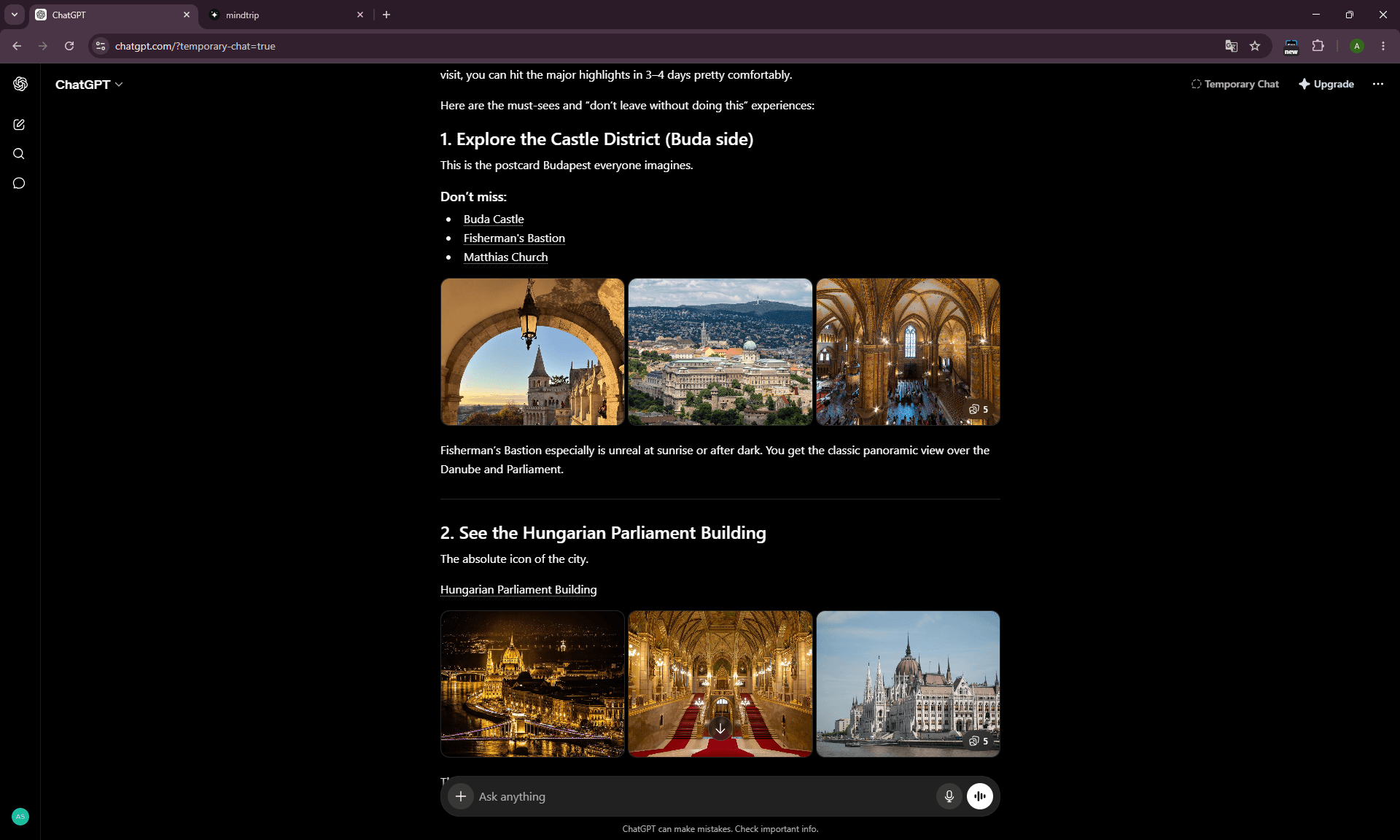
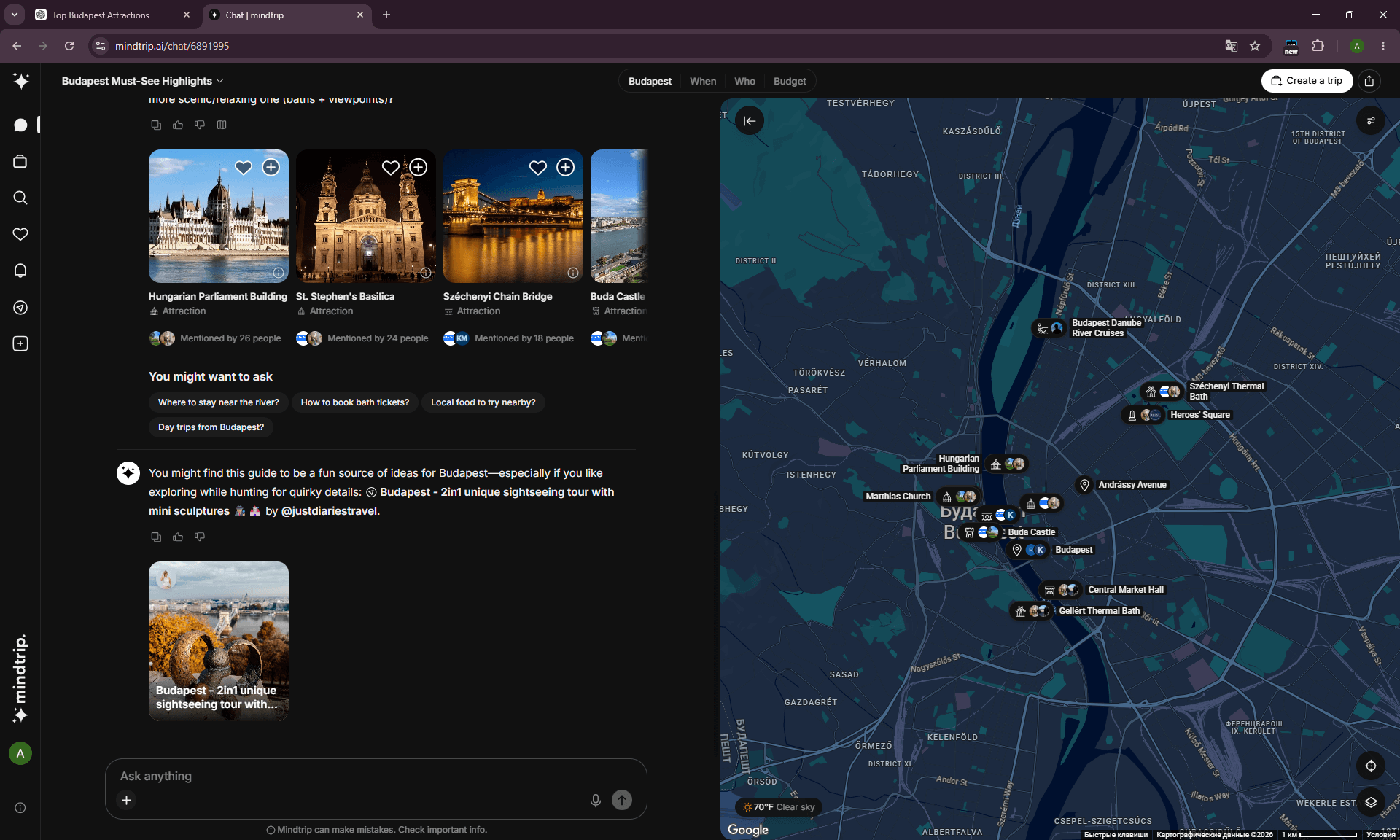
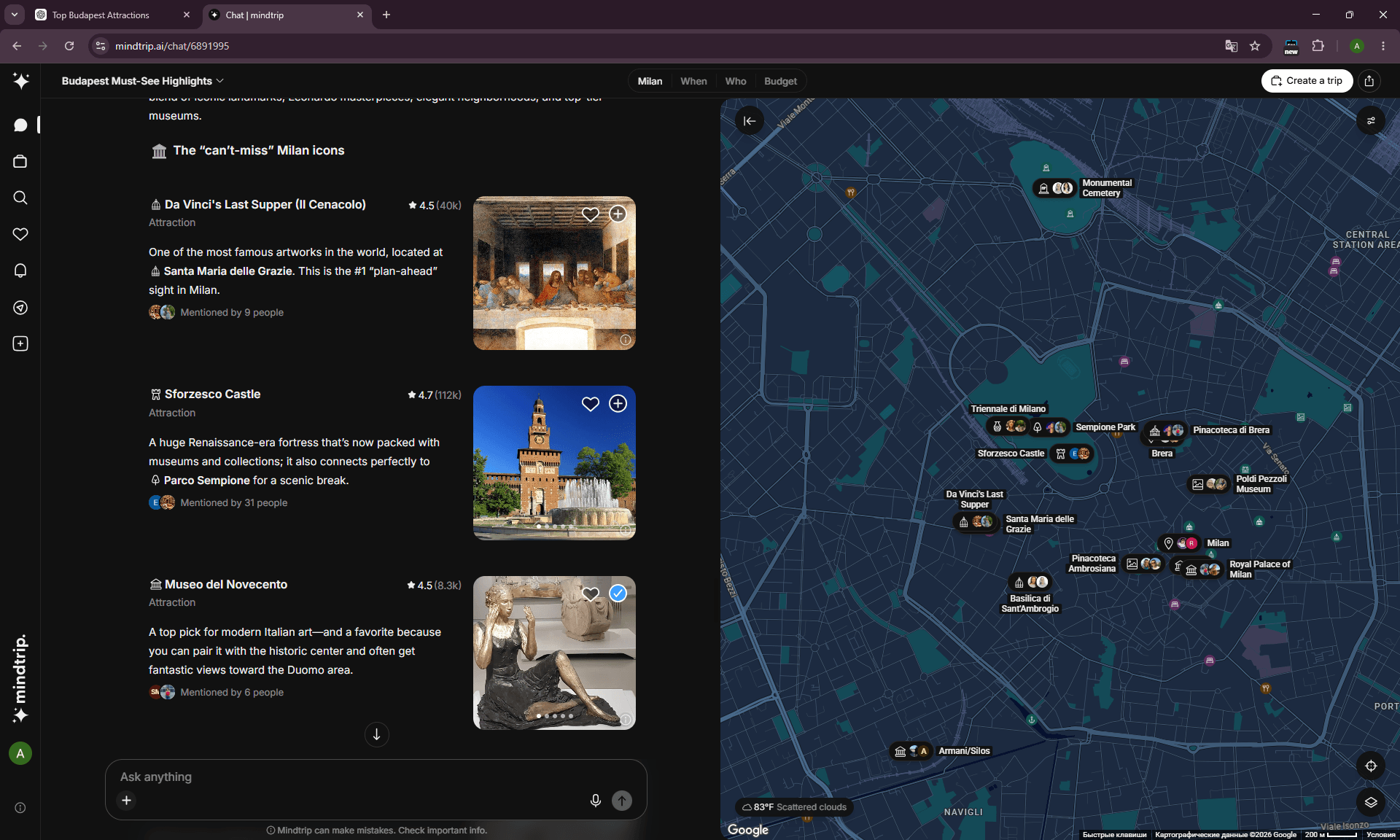
Budapest. ChatGPT returned parliament, Buda Castle, Széchenyi Baths, Chain Bridge, St. Stephen’s Basilica, the Central Market, the “Shoes on the Danube,” ruin bars. Mindtrip gave the same backbone plus Fisherman’s Bastion, Matthias Church, and a Danube cruise. Two different tools, one identical postcard set. The aquarium — not a hint of it anywhere.
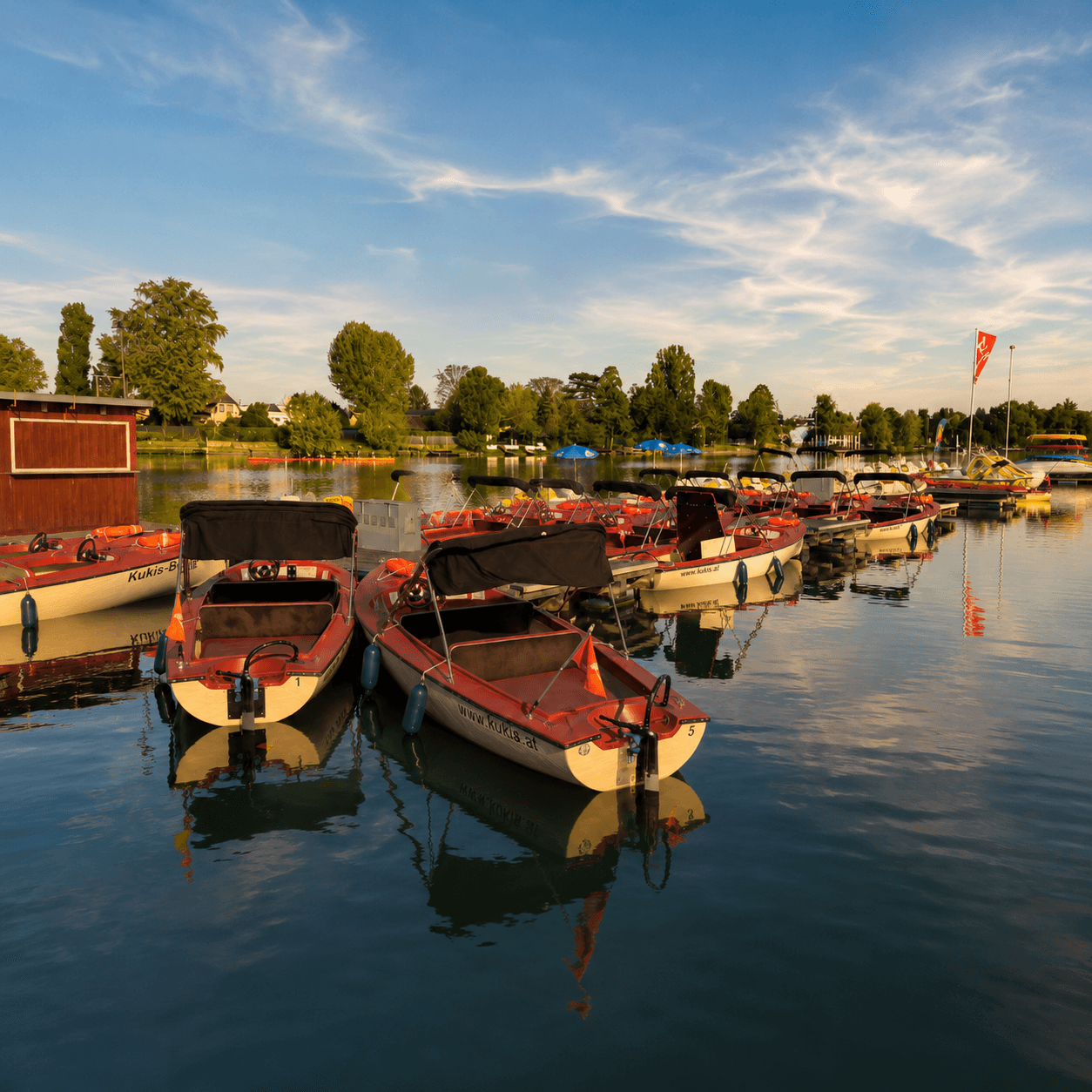
Vienna. Schönbrunn, Hofburg, St. Stephen’s Cathedral, Belvedere, the MuseumsQuartier, the Vienna State Opera — both ChatGPT and Mindtrip, almost line for line. Alte Donau, the quiet old-Danube oxbow lake where Viennese people actually take boats out, has no business being on a list like this — too “not top.”
Brno. Špilberk Castle as item one, the cathedral, the bone ossuary, Villa Tugendhat, beer culture, the city reservoir. Solid, historic, very grown-up. The interactive science center we essentially traveled there for, with a kid in tow — zero mention.
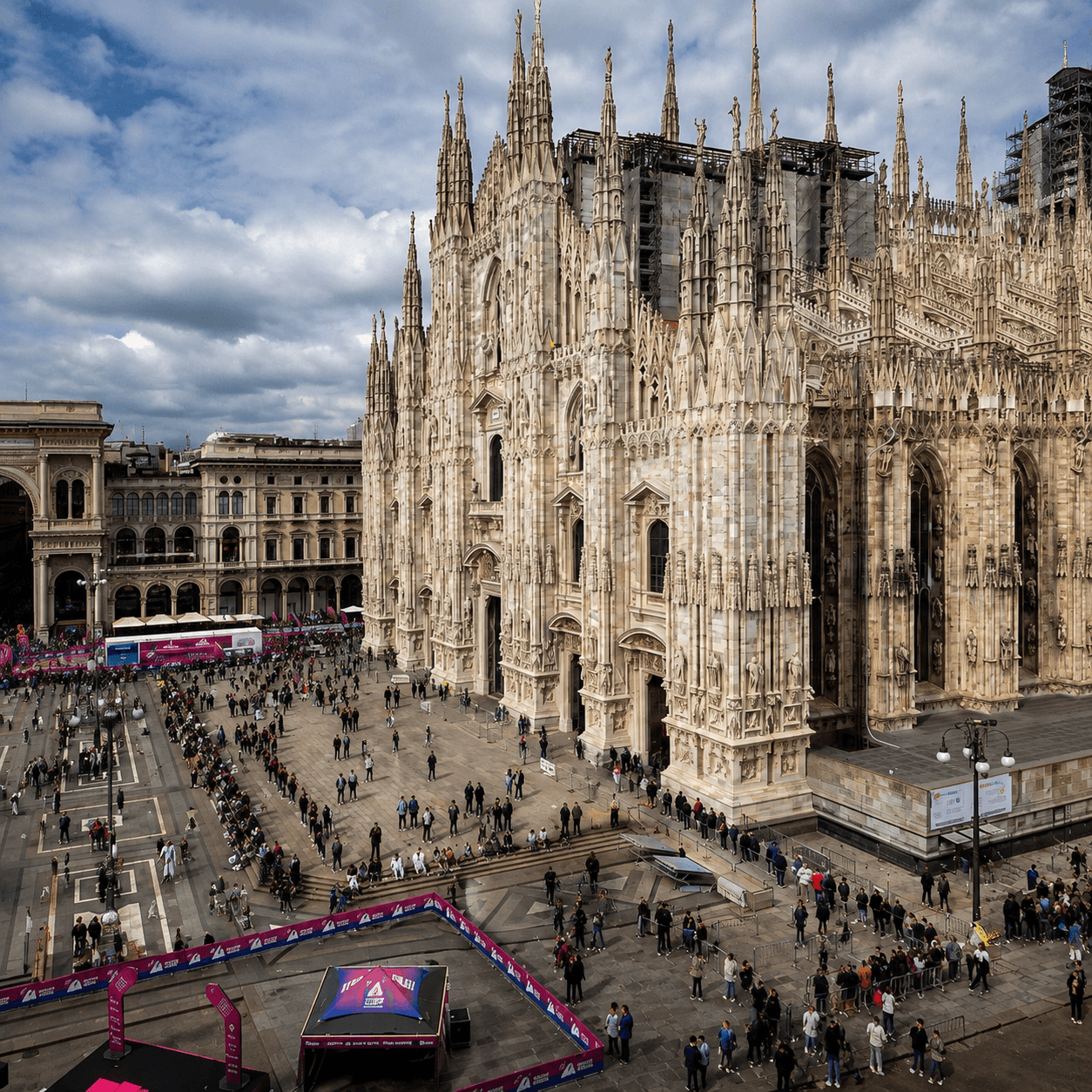
Milan. The Duomo, the Galleria Vittorio Emanuele, the Last Supper, the Sforza Castle, the Brera district, La Scala. Mindtrip, to its credit, also pushed in the Pinacoteca Ambrosiana — the very place my wife would later quietly walk past. Hold that thread; it pays off below.
Normandy. Mont-Saint-Michel, the D-Day beaches, Honfleur, Rouen. There’s a wrinkle here, but I’ll get to it in case #5.
Every one of those five lists is impeccable, factually correct, and personally useless. Useless not because it’s bad, but because it’s identical from one traveler to the next. If you’re going to Budapest for one day and have never been, take any of these and don’t look back. If you have an eight-year-old obsessed with sharks, or a wife looking for a working reading room rather than a museum-piece library, the list gave you nothing.
That, in short, is the prompt problem: the question “what should I see” returns what everyone sees. The obvious next move — and the one I tried — is to ask for “hidden gems” and watch the tool switch lanes. I assumed that would work. It didn’t.
I Asked AI for Hidden Gems — Here’s What Happened
Second pass. Same prompt across all five cities, in both tools:
“What are some hidden gems and non-touristy things to do in [city]? I want to avoid the usual tourist spots and see places locals actually go.”
And this is where it got genuinely interesting. The tools did switch lanes — just not the lane I was hoping for.
Instead of parliament and the Duomo, I got a different list. Creative neighborhoods to wander “without a checklist”: Újlipótváros and Bartók Béla Boulevard in Budapest; Neubau and Josefstadt in Vienna; Isola, Porta Venezia, and NoLo in Milan. Baths “quieter than Széchenyi” — Dandár, Veli Bej. Cemeteries-as-museums: Central Cemetery in Vienna, Monumental Cemetery in Milan. Design galleries and independent art spaces. Wine bars instead of “touristy pubs.” And a steady stream of “real city moments”: “ride the tram at night in the rain,” “push open a tall wooden courtyard door — there might be a bar inside,” “sit in a café with a book for two hours, no one will hurry you.”
It sounds atmospheric. Borderline tempting. There’s exactly one problem: this list was nearly identical for every single city. ChatGPT in particular produced almost the same outline in every direction — “neighborhoods to wander without a checklist,” “baths locals actually use,” “weird and overlooked,” “food locals eat,” a block of “very [city] moments,” and a closing offer to give “a 3-day local itinerary, hidden cafés, underground music, vintage shops, a brutalist walk.” Only the proper nouns inside the same template changed.
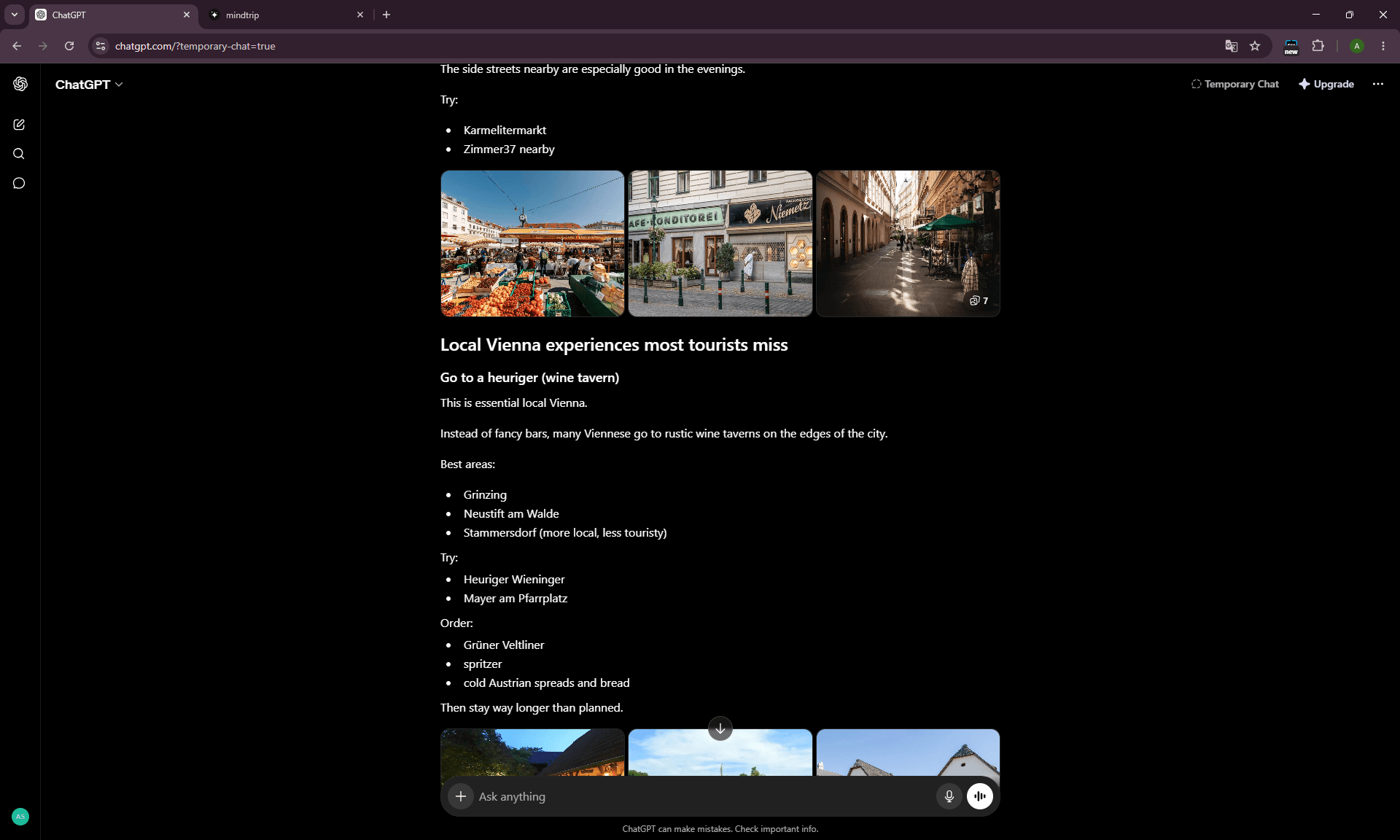
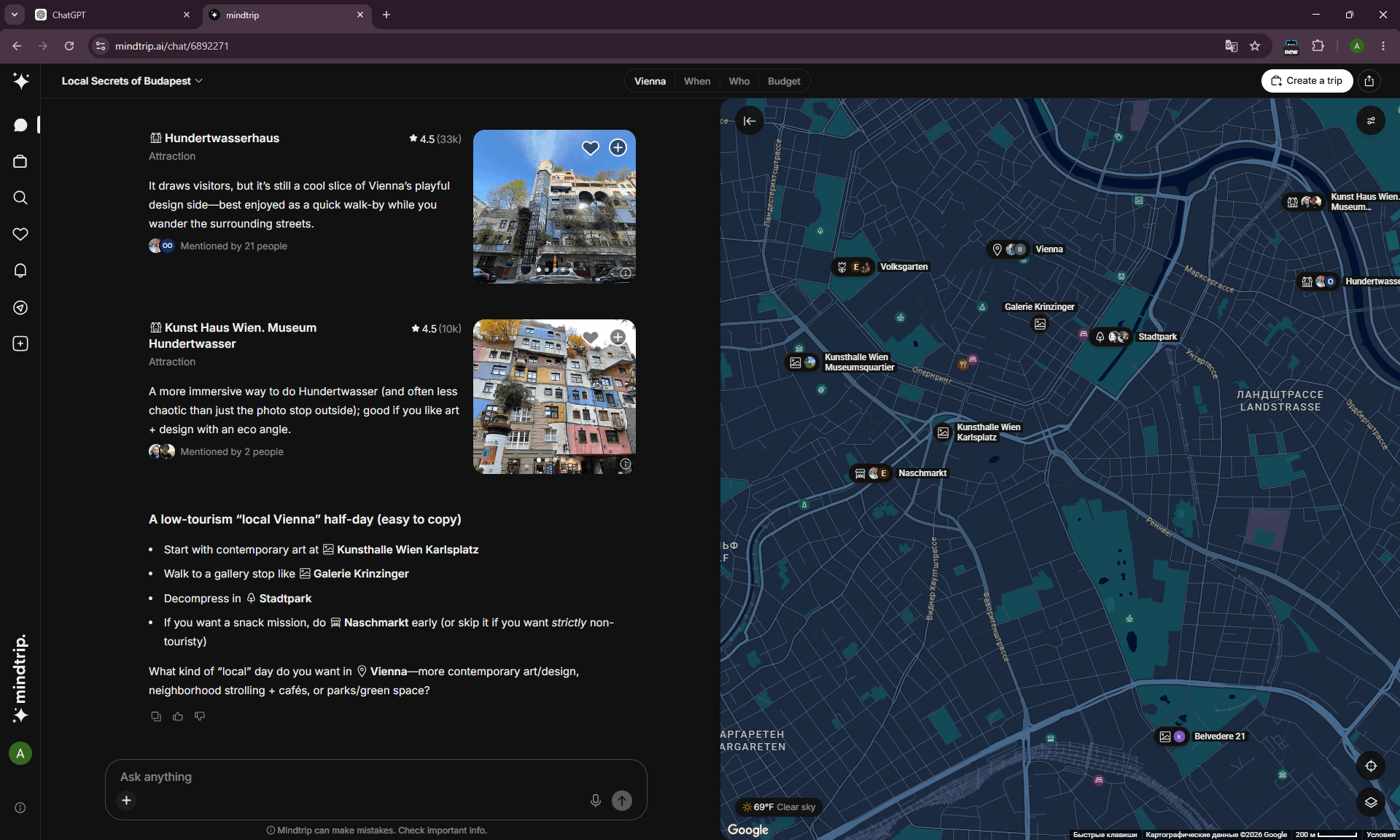
I started calling this templated authenticity — the Instagram version of “not as a tourist”: a set of recognizable markers of “authenticity” that have, themselves, long since become mainstream. The cemetery-as-hidden-gem trope exists in every city. The creative neighborhood with wine bars exists in every city. The “quiet bath for locals” exists in every city. That isn’t your off-beat. That’s an averaged, statistically computed off-beat, scraped from the same articles — just from a different section of them. The model didn’t stop answering with consensus; it just switched to the consensus idea of what counts as non-mainstream.
And here’s the big number from this round. On a direct request for “hidden gems,” out of five of our real places, AI still missed four.
| Place (city) | Generic prompt | “Hidden gems” prompt | Context-anchored prompt |
|---|---|---|---|
| Tropicarium (Budapest) | Missed / Missed | Missed / Missed | #1 / #1 |
| VIDA (Brno) | Missed / Missed | Missed / Missed | #1 / #1 |
| Braidense (Milan) | Missed / Missed | Missed / Missed | Named / #1 |
| Alte Donau (Vienna) | Missed / Missed | Named / Missed | — |
| Étretat (Normandy) | Named / Named | tool said “too crowded” | — |
Cell format: ChatGPT / Mindtrip. The “context-anchored prompt” column is the punchline of the whole piece — we unpack it in the section on actually using AI for hidden gems.
Notice: asking for “hidden gems” didn’t move us much closer to our gems. The single exception is Alte Donau in Vienna, named by ChatGPT — and that exception is so revealing that I’ve broken it out as its own case below. It explains why AI finds some hidden gems and not others.
5 Real Hidden Gems AI Missed (Across 5 Real Trips)
Five places. Five real days from our trips. For each one: what AI suggested instead, what we actually found, and — most importantly — why it missed. Some of these stories I’ve already written up in trip reports; here I’m looking at them through a different lens, as data points.
1. Tropicarium Instead of the Zoo (Budapest)
We opened with this, so I’ll be brief on the story and longer on the mechanics. The entire Central Europe road trip was planned with AI acting as our travel agent, and on the question of “what to do with a kid in Budapest” it confidently routed us to the zoo — both on the generic prompt and when I specifically asked for kid-friendly things. The zoo is genuinely great. But my daughter wanted an underwater world, and Tropicarium — with its shark tunnel and stingray touch-pool — was exactly the right answer. On neither the generic nor the “hidden gems” prompt did it appear for either ChatGPT or Mindtrip.
A quick credibility note, because this matters: this isn’t our first aquarium. We’ve been to the big one in Barcelona; we’ve been to the small but extraordinary aquarium in the Faroe Islands, where the kids were allowed to handle crabs, mussels, and a starfish with their bare hands. I know the soundtrack of an eight-year-old’s “wow” in this genre well. At Tropicarium, the “wow” was absent. Something else happened instead: she went still, opened her mouth, and silently pointed a finger at the shark drifting over our heads. She had never done that anywhere else, in any aquarium.
Why AI missed it: an aquarium in a shopping mall on the southern edge of the city fits none of the templates the model operates on. It’s not “postcard-grade top sight.” It’s also not “atmospheric off-beat” (baths, cemeteries, creative quarters) — too on-the-nose family. It fits exactly one category: “I have a kid who’s obsessed with marine animals.” And that piece of context wasn’t in the question I’d asked. The information about the place existed in the model. The missing piece was the link between place and us.

2. VIDA Instead of Špilberk Castle (Brno)
Brno is a soft spot for me, and I’d say it’s the city that most benefits from going non-touristy. By default AI routes you to Špilberk Castle and the cathedral: beautiful, historic, designed for adult attention spans. We went to VIDA! Science Centre instead — a sprawling interactive science museum built entirely around hands-on. Generate tornadoes. Launch objects under pressure. Ride a bike across a tightrope. Experiment with water, light, sound, magnets. Plenty of museums say “interactive” and mean a single touchscreen near the entrance; VIDA is built around touch from the floor up. My daughter spent half a day there and left under protest.
This is also where the single most intriguing observation of the whole test happened, the one about AI memory. When I asked the generic Brno question inside my personal ChatGPT account — the one with memory turned on — it pulled up VIDA on its own, without any nudge, and explicitly cited the fact that I’d shown interest in kid-oriented science museums on past trips. Switch over to a clean chat with memory off, and VIDA disappears entirely; you’re back to the castle, the cathedral, and the ossuary.
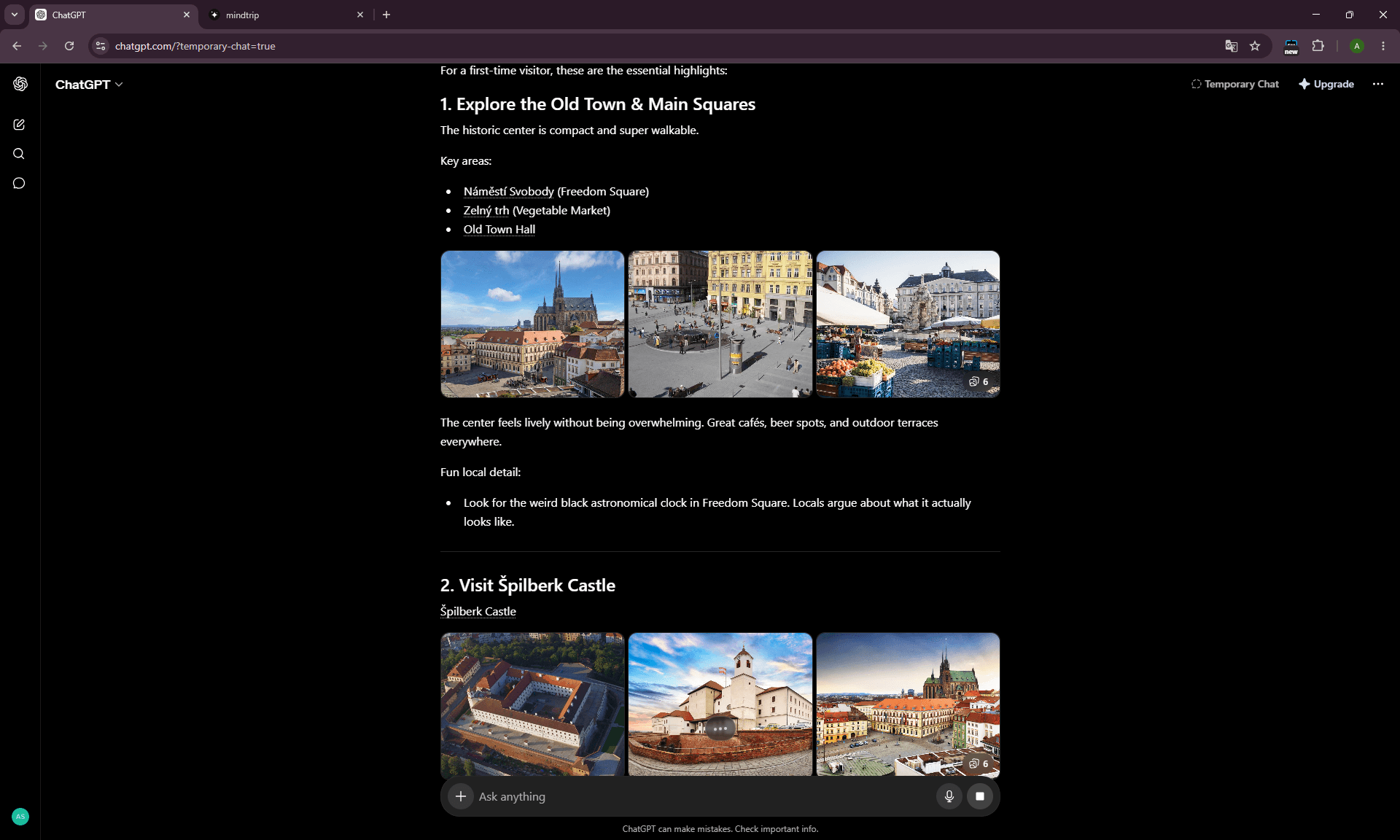
That’s not a bug, and it’s not a “rigged test.” It’s the article’s thesis in its purest form: an AI that knows you behaves smarter. Memory isn’t a privacy threat to be panicked about and shut off; it’s a tool to be deliberately switched on. I’ll come back to this in the section on right-side-of-the-prompt usage — it’s part of the recipe, not a side effect.
3. Braidense Instead of the Ambrosiana (Milan)
This is, hands down, my favorite case in the test, because it shows the inversion in the most literal way possible. During our Milan and Lake Como trip every tool kept recommending the Pinacoteca Ambrosiana: Codex Atlanticus by Leonardo, “you can’t skip it.” On the generic prompt that was exactly what Mindtrip surfaced — a textbook mainstream pick.
But my wife wasn’t looking for a museum-piece library you walk through in a tour group. She was looking for a working reading room — a living library where people genuinely sit and read for hours. The place that turned out to fit that was the Biblioteca Nazionale Braidense in the Brera complex: long wooden tables, readers under chandeliers, soft lamp light, the kind of silence that’s used rather than performed for the camera. The distinction is real and important: the Ambrosiana is “come and look”; Braidense is “come and stay.”
What hit my wife hardest, though, wasn’t the architecture of the room. It was the books themselves — leather-bound, gold-tooled, several centuries old, sitting on shelves and lying on the tables by the dozens. Not under guard, not as museum exhibits behind glass, just part of the working collection of a functioning library. Three impressions stacked one on top of the other. First: that centuries ago, long before any of our modern technology, people could make this with their hands — the binding, the paper, the stitching, the gold tooling. Second: that the books survived this well, looking almost as if they’d just been re-bound. And third, quietest of all: that dozens of generations of human hands had held them before hers. The person who made them had been dead for centuries. The people he’d passed them on to, dead for centuries too. The number of hands between the maker and today’s reading table is uncountable.
And then something happened that no trip planner would have thought to anticipate. After leaving Braidense, we wandered into an antique book stall in Milan — one of those outdoor mercatini where eighteenth-century volumes are stacked in piles. And there, the same kind of books could actually be held in your hands. Braidense shows them in “come and sit nearby” mode; the stall hands them over physically. My wife held a copy of Physiologia Medica by Georg Wolfgang Wedel — Jena, 1704, more than 320 years old. And all three of her library impressions, which had been living at table-distance, suddenly became tactile. The craftsmanship she’d watched from across the room was now in her palms. The preservation became a weight, a leather texture, a slight brittleness of paper. The “dozens of generations of hands” stopped being a metaphor and became faintly visible wear marks on the cover. The arc see in the reading room → walk outside → hold in your hands turned out to be the single most memorable moment of our entire Milan trip. Neither of the tools I was testing would have surfaced it. No guidebook would have either.

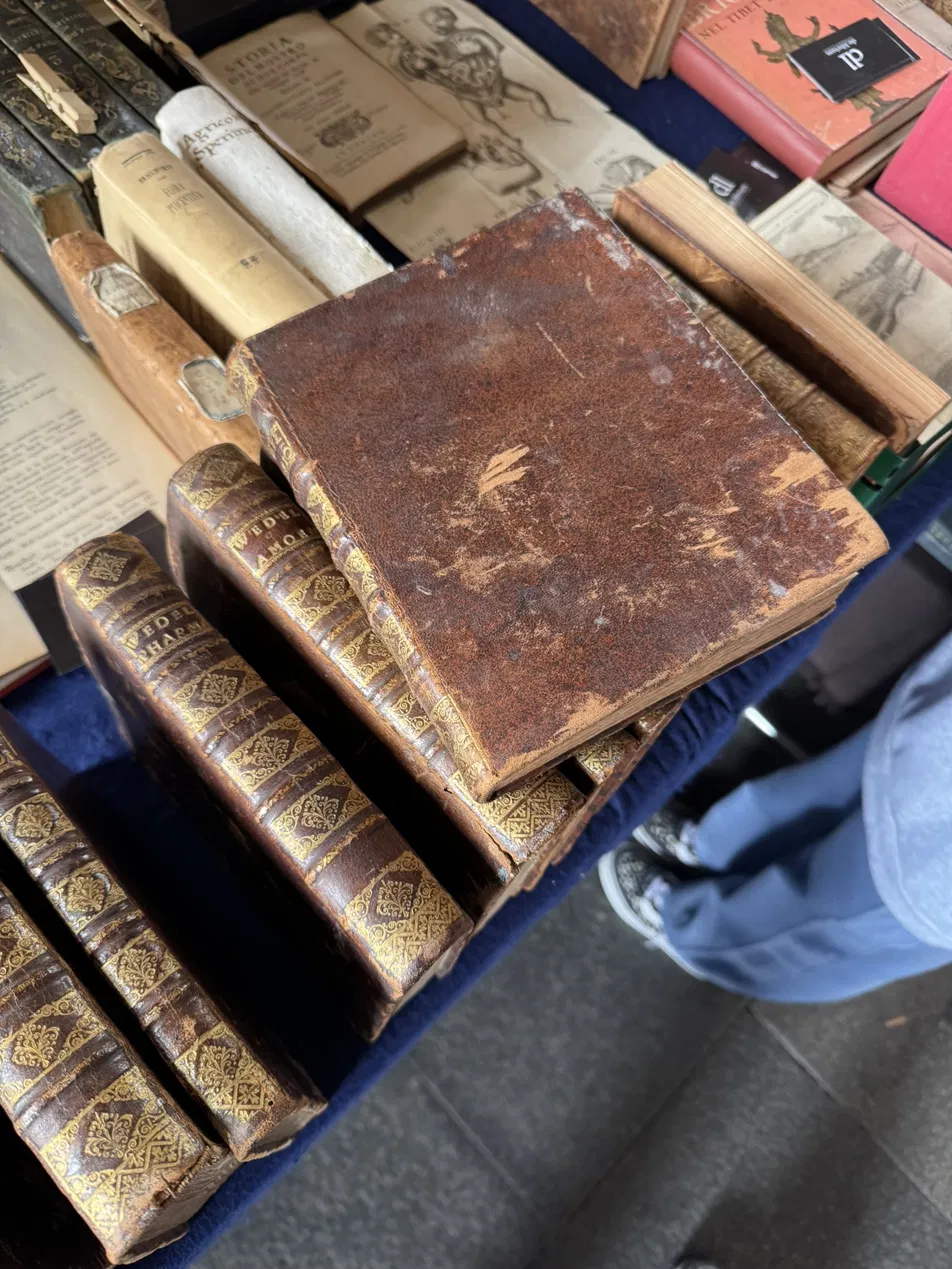
On neither the generic nor the “hidden gems” prompt did Braidense or the stall surface, in either tool. The Ambrosiana did, because mainstream. Braidense didn’t, because it fit her specifically, and AI’s default doesn’t distinguish between “famous library” and “library you want to spend two hours in, surrounded by 300-year-old books.” The book stall didn’t because it’s not even an object on a sights list. The connection between those two points — that’s something only a human standing on the ground can build.
4. Alte Donau — The Place AI Did Find (Vienna)
Now the honest case — and the one that, oddly enough, makes the whole article stronger. In Vienna, the default AI recommendation was a touristy Danube cruise — the standard riverboat thing. We, instead, rented a paddle boat on Alte Donau, the “Old Danube” — a quiet oxbow on the edge of the city where Viennese people pedal around in slow boats, sit in the lakeside cafés, and swim after work. Our daughter steered the boat herself. It was one of the calmest and happiest evenings of the trip — and not a single tourist in any frame.
The kicker: on the “hidden gems” prompt, ChatGPT named Alte Donau by itself — describing “paddle boats, lakeside cafés, evening walks,” almost word for word what we did there. Mindtrip didn’t. But one of the two tools genuinely hit the target.
Why this place and not Tropicarium, VIDA, Braidense? Because Alte Donau is a known-quiet-place. It slots perfectly into the model’s “quiet local spot by the water” template — the very template AI does manage to surface on a hidden-gems query. Whereas an aquarium for a specific kid, an interactive science centre, and a working historic library aren’t a “genre of quiet place.” They’re you — your people, your interests, your constraints, none of which can be inferred from generic data.
There it is, the findability gradient — and it’s the intellectual core of the whole article:
- Places that fit a general template of “local / quiet / atmospheric” — AI finds them (Alte Donau).
- Places that emerge from your specific situation — AI doesn’t find them, until you spell that situation out.
Showing you that one of the five actually got hit by AI matters more to me than a clean “missed them all” score. First, because it’s true. Second, because this is exactly the case that explains how to fix the other four.
5. Étretat — Not a Case About Knowledge, but About Route Planning (Normandy)
The fifth case is special, and I’ll handle it as honestly as I can, because otherwise you’ll catch me out on a contradiction. The Étretat cliffs are not a hidden gem. Not even close. They’re among the most photographed cliffs in France, Monet painted them, they appear on every Normandy list ever published. AI knows them perfectly: on the “hidden gems” prompt, Mindtrip actually warned me — “beautiful but crowded; if you want cliffs without the scene, head to the Cap de la Hague footpaths instead.”
So AI doesn’t just know Étretat. It actively crossed it off the gem list itself, on its own initiative, as too well-known. Where, then, was the miss during our France road trip? It was in the route, not in the knowledge. When Mindtrip planned the actual itinerary, it optimized the day around Mont-Saint-Michel — the headline attraction of the region — and Étretat simply didn’t make our route. Not because the tool didn’t know about Étretat, but because at planning time it tends to gravitate to the most “obligatory” landmark and doesn’t ask what matters to you.
This is a different kind of blindness than the first four cases. There, AI failed to surface the right place. Here, it knew the place perfectly but didn’t account for us when ranking. The fix happens to be the same — context — but it’s important to see the distinction: sometimes the miss isn’t in the model’s volume of knowledge, but in how it ranks and what it decides is “the main thing” on your behalf.
A bonus, completely unplanned by anything or anyone: the walk from the parking lot to the town center took us past the house associated with the author of Arsène Lupin. We’d been watching the Netflix series Lupin not long before the trip, and for our daughter the cliffs and the promenade suddenly went from “pretty” to “familiar.” Look, that’s where they walked. That’s the semicircular café from the show. That’s where they got into the car. The reaction was the opposite of the Tropicarium one — not silence, but a steady stream of recognitions and commentary. And no planner would have made the connection Étretat + the Lupin series we’d just finished, because the planner has no idea what we were watching last week. That, in miniature, is the answer to “why AI needs your context”: not because it knows Normandy badly, but because it has no clue what we were streaming on Tuesday.

What AI Actually Does Find Well
If after five cases the impression is that I’ve written AI off as useless — no. That would be both dishonest and inaccurate. For the picture to stay balanced, I owe you the list of things the tools are genuinely good at, the things I use in every trip.
Famous sights and the context around them. If you actually want the Duomo, Schönbrunn, or Mont-Saint-Michel — AI will hand you history, opening hours, ticket strategy, the right route through, and warnings about the queues. This is a real time-saver compared to manual research.
Logistics and timing. How to get there, how long to budget for an attraction, what combines geographically, how not to crisscross a city in random zigzags — strong territory, and especially strong for Mindtrip with its maps and routing. On that ground it’s genuinely good.
Well-documented restaurants and basic “local” recommendations. Wherever a place has a thick body of reviews and write-ups, AI navigates with confidence: the aperitivo neighborhood, the typical dish, a reliable trattoria.
And — known-quiet places. The Alte Donau case. If your gem is both popular with locals and documented in the literature, AI will find it even on a hidden-gems prompt, with no tricks required.
The line runs exactly along the personalization axis. Everything inferable from general data, AI infers well. Everything that requires knowing your specific situation — who’s going, what they love, what they want to avoid — it misses, until you give it the situation as input. Which brings us to the main thing.
How to Actually Use AI to Find Hidden Gems
This is the pivot of the whole piece. I took the three cities where both tools had cleanly missed on the first two passes (Budapest, Brno, Milan), and I asked the question differently. Not “find hidden gems” — that, as we established, delivers templated authenticity — but a question with my family’s actual context baked into it.
For Budapest, it looked like this:
“I’m visiting Budapest with my 8-year-old daughter who loves marine animals and aquariums. Skip the famous tourist sights — name specific, lesser-known places in or near Budapest that match this exact interest. Give actual venue names, not neighborhoods or categories.”
The result? Tropicarium — item #1. In both tools. ChatGPT led with it, gave the full address (Nagytétényi út, inside the Campona shopping center), described the shark tunnel and the ray touch-pool, and even noted that “this is where locals quietly take their kids when they’ve had enough of castles and churches.” And then, unexpectedly, kept going — adding several genuinely niche options under the same interest. Pákásztanya, a tiny aquatic-themed educational outpost attached to the zoo. Lake Tisza Ecocenter a day’s drive away, one of the largest freshwater aquariums in Europe, where foreign tourists barely set foot. The Oceanarium in Nyíregyháza for serious shark-obsessives. Mindtrip went the same way: Tropicarium first, plus Biodóm, plus even a fish farm just outside the city.
Same magic in Brno. On the context-anchored prompt (“eight-year-old, loves hands-on and experiments”) both tools led with VIDA, with ChatGPT calling it “the jackpot” and adding a whole secondary program: the Technical Museum as “a warehouse of cool machines” for a rainy day, the observatory with a planetarium for the evening, the Papilonia butterfly house, the Otevřená zahrada eco-garden with interactive outdoor installations. Mindtrip rounded out VIDA with the Technical Museum and the Mendel Museum — for a child who likes “how things work.” What had been “castle and cathedral” on the cold query turned into a saturated two-day kids’ itinerary under context.
Milan delivered the prettiest illustration of the lot. On the context-anchored prompt (about a wife who loves historic libraries and quiet working reading rooms), ChatGPT didn’t just find Braidense — it actively recommended deprioritizing the Ambrosiana, calling it “too museum-flow energy, a tourist current,” and pointing toward living reading rooms instead. The exact inverse of what the same class of tool had been recommending on the generic prompt. And it laid out a whole fan of options matched to a precise request: the Sormani library inside an aristocratic palazzo, the modern Ostinata, the quiet Chiesa Rossa by the canal, the Politecnico university library for an “academic evening” mood. Mindtrip put Braidense first and quietly reframed the Ambrosiana — “go to the reading room side, not the gallery part.”
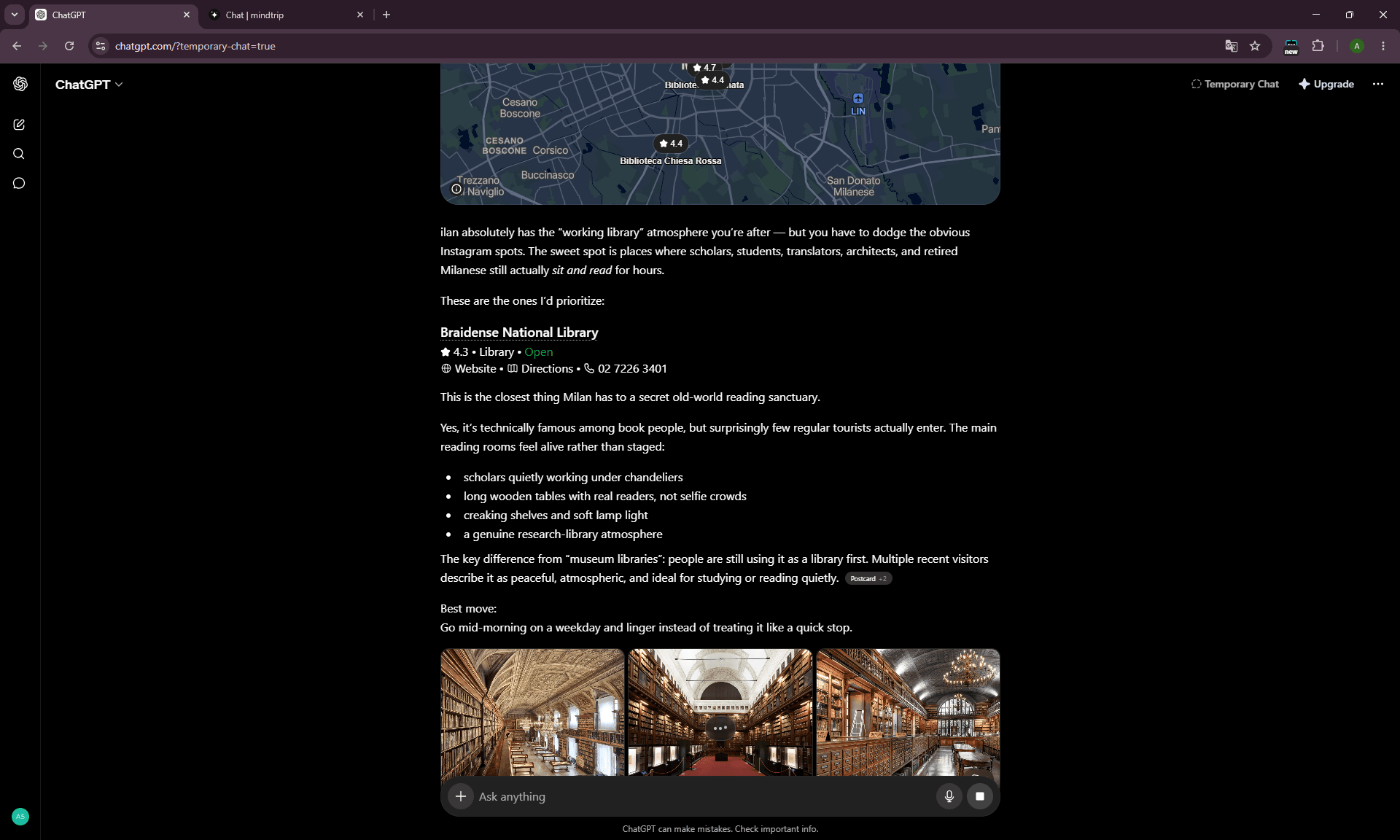
And one more detail that’s hard to overlook: under a context-anchored prompt, ChatGPT stopped guessing and started searching. Real addresses appeared in the answers. Phone numbers. Links to local sources and Reddit threads. Give it a real mission instead of a generic question and it stops pouring out averaged consensus and goes after specifics, with sources.
The takeaway, the one I built the whole experiment for: AI isn’t dumb — it just answers the question you asked. Ask vaguely, get a vague answer. Give it your context, get your places. This isn’t a “magic prompt hack.” It’s plain logic: the tool isn’t a telepath, and it has no idea you have an eight-year-old with sharks in her head until you say so.
5 Prompts That Actually Surface Gems
A working set, tuned on the test. Copy, substitute your city and situation.
1. Constraint anchor (the heavy lifter). The strongest of the five. Bake into the prompt who’s traveling and what they care about — specifically, no euphemisms.
I’m visiting {city} with {who’s traveling and key interest}. Skip the famous tourist sights — name specific, lesser-known places that match this exact interest. Actual venue names, not neighborhoods.
2. Local persona. Make the model speak in a resident’s voice, not a guidebook’s.
Pretend you’re a local who’s lived in {city} for 20 years and is slightly tired of tourists. Where do you actually take out-of-town friends who want the real city, not the top-10 list? Give 5 specific places and why locals like them.
3. Exclusion. Cross the mainstream out by force — the model has to walk past the first page of results.
List the 10 most famous tourist attractions in {city}. Now exclude all of them and give me 7 worthwhile places that would NOT appear on a typical “top things to do” list. For each, say who it’s best for.
4. Activity, not landmark. Switch focus from “what to see” to “what to do” — that’s how things like a paddle boat on a local lake surface, instead of a tourist cruise. This is the move that would have produced Alte Donau on purpose, rather than by accident.
Forget landmarks. We want a relaxed half-day {activity — e.g., on the water with kids} in {city} that locals actually do, not a tourist tour. Name specific spots and how to do it like a local — rentals, prices, where to start.
5. Self-audit. Take AI’s own answer and force it to critique itself.
Here are the “hidden gems” you suggested for {city}: [paste the list]. For each, be honest: is it actually off-the-beaten-path, or now a well-known tourist spot? Which are overrun, which need advance booking, and which are genuinely quiet?
Prompt #1 is the one that surfaced all three places in the test, at the top of the list, in both tools. Prompt #5 pairs nicely with any of the others — it pre-filters the templated authenticity by making the model expose its own clichés. If you want another fifty or so ready formulations for different travel tasks — budget, routing, itineraries — I keep a separate collection of 50+ ChatGPT travel prompts where the Cross-Check Prompt gets its own deep dive.
And don’t sleep on memory. In ChatGPT, having memory turned on is less “surveillance” and more “let the tool learn your taste once and stop re-explaining it every chat.” My account, which remembers our family’s science-museum thing, found VIDA unprompted. The cold one didn’t. Memory turns the constraint-anchor from a one-shot trick into a steady background — the tool starts surfacing “your” places by default.
ChatGPT vs Mindtrip for Finding Hidden Gems
After all three rounds — a short side-by-side on the specific task of finding the non-touristy, no fluff.
| Criterion | ChatGPT | Mindtrip |
|---|---|---|
| Generic prompt | Pure mainstream | Pure mainstream |
| “Hidden gems” prompt | Templated, but caught Alte Donau | Templated, missed Alte Donau |
| Context-anchored prompt | Gem at #1 + addresses, sources, phone numbers | Gem at #1, follows up with clarifying questions |
| Memory / personalization | Yes — learns your taste over time | No |
| Strongest at | Depth under context, grounding in sources | Maps, routing, “asks before answering” |
The short version: under a good context-anchored prompt, ChatGPT is sharper. Mostly because of memory, and because under a real mission it goes hunting in actual sources rather than averaging. It was the one that found Alte Donau on the hidden-gems prompt, and the one that, on its own, told us to skip the Ambrosiana in favor of Braidense.
Mindtrip, meanwhile, holds logistics with a steady hand, draws the map, and likes to push a clarifying follow-up — “what does she actually enjoy, what kind of neighborhood?” That structural nudge alone forces you to provide more context, and context, as we keep finding, is the key to everything. So Mindtrip makes you ask the right question, even when you weren’t planning to.
Neither is “better” in a vacuum — they’re strong at different things. I’ve gone deeper on each in the full Mindtrip review and the Layla AI review; a direct three-way comparison on a single shared itinerary lives in Layla vs Mindtrip vs Wonderplan. If you’re still picking a tool from scratch, the best AI trip planners roundup is your starting point, and the iMean AI review covers the alternative track.
AI Can’t Find Your Places Until It Knows You
Five trips, two tools, the same lesson on repeat until it can’t be missed. Asked “what should I see,” AI answers in the averaged voice of every guidebook ever written. Asked “find hidden gems,” it serves the Instagram version of off-the-beaten-path, almost identical from one city to the next. And only when you slip yourself into the prompt — who’s going, what they love, what they want to skip — does it find your places. In our test, that worked across all three of the “failed” cities at once: Tropicarium, VIDA, and Braidense all snapped to the top of the list, as if they’d never been hidden.
Because they weren’t. The gem is almost certainly already in the tool’s data — it’s just buried under what gets recommended to everyone. The task isn’t to find a “secret” tool; it’s to ask the one in your hand the right question.
So next time AI suggests the zoo when your kid is dreaming of sharks — don’t close the chat in frustration. Rewrite the question. Tell it who you are. Give it context. And the gem will float up to the first line.
Tropicarium was waiting for us the entire time. We just had to ask differently.
Every itinerary in this piece is from real family trips across Europe. The test screenshots were captured in ChatGPT and Mindtrip in 2026. Tested on real trips — not just desk research.